by California Casualty | Health |
Time is of the essence for stressed out nurses, time crunched educators or first responders on the go. Now that school has begun and schedules are getting even tighter, meal planning can be a real chore. Picking up a bag of salad, prewashed carrots or other veggies can be a real timesaver, but are we making the healthiest choice for our families?
Here’s some good news from The Cleveland Clinic. They’ve found that pre-cut vegetables are just as nutritious as whole vegetables, and even offered tips on how to pick the best bagged varieties:
- Make sure to buy raw, not pre-cooked varieties for the most nutrition
- Check that they are refrigerated for freshness
- Inspect labels for use-by dates
- Consume within a few days before vitamins break down
- Watch for chemicals
The Clinic does warn pregnant women to be very careful with any fresh or pre-cut foods to avoid e-coli and other dangerous bacteria.
And speaking of food safety, Dr. Stephen Swanson of the Centers for Disease Control tells Eatingwell.com that most bagged vegetables and salads may actually be safer than their raw counterparts because they are washed multiple times in a solution of chlorinated water. It’s enough, he says, to kill pathogens, but in small enough levels as not to be a consumption concern.
Cooking for the family after a hectic day doesn’t have to eat up a lot of time. Realsimple.com has a list of 20 speedy recipes that take 15 minutes or less to prepare to accompany those bagged selections:
by California Casualty | Health |
With spring time almost here, home maintenance can become a task added to the workload. But have you considered it being a work-out?
Whether you only have 15 minutes or an hour, here are some ways to burn those calories while working around the house.
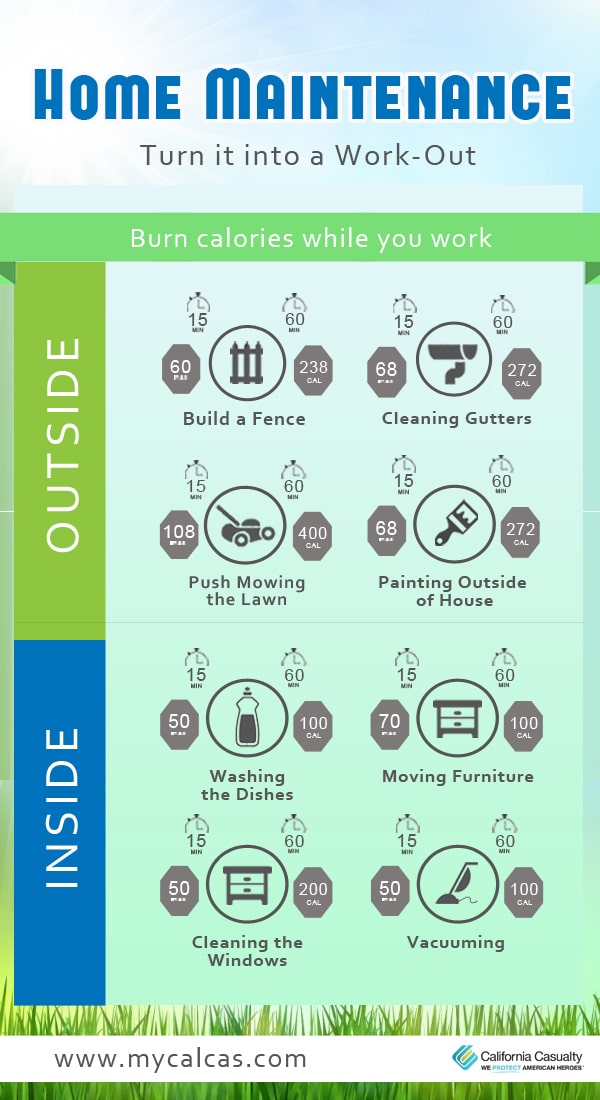
Outside:
- Building a fence: 85 calories for 15 min / 340 calories for 60 minutes.
- Cleaning gutters: 68 calories for 15 min / 272 calories for 60 minutes.
- Push mowing the lawn: 108 calories for 15 min / 400 calories for 60 minutes.
- Painting outside of the house: 68 calories for 15 min / 272 calories for 60 minutes.
Inside:
- Washing the dishes: 100 calories for 60 minutes.
- Moving furniture: 100 calories for 25 minutes.
- Cleaning the windows: 100 calories for 30 minutes.
- Vacuuming: 100 calories for 60 minutes.
Getting a jumpstart on spring cleaning can not only tidy up things around the house, but also help get in shape. Do you have any house chores that you could add to this list? Let us know what you think by commenting below.
Sources:
https://news.health.com/2013/04/22/10-chores-that-burn-100-calories/
https://www.houserepairsyourself.com/?p=1306
by California Casualty | Health |

I admit it; I am a dog-person.
Our dog gives us such great joy. She’s loving, goofy and brings smiles and laughs to our entire family. We enjoy long runs and hikes, and play ball for hours.
I understand that not everyone is a dog or cat lover; they shed, are often needy, and keeping them healthy and well fed can be costly. Then there’s the hassle of finding them a place if you have travel plans.
But those of us with a pet-friend know how much they enrich our lives. Now, many experts say there is proof that life with a pet may actually provide multiple health benefits. Here are five healthy reasons why you might want to get a pet this New Year:
- Reduced allergies – more and more studies suggest that infants and children that grow up in a house with furred animals have a reduced risk of allergies and asthma later in life
- Lower blood pressure – numerous studies find merely being around a pet can lower your blood pressure, with the greatest drop coming when you pet them
- Better heart health – dog owners have a lower risk of heart disease and those suffering from heart disease had better recoveries and survived longer if they had a pet
- Increased companionship – pet owners are less likely to suffer from depression, Alzheimer patients were calmer when pets were present and many elderly people reported a better quality of life because of their pets
- Decreased weight – those of us with pets tend to go to dog parks, take regular walks, hikes or runs with their dog, and were less likely to be overweight
There are other ways pets are adding to the well-being of their owners: therapy and companion dogs can warn people about food ingredients they might be allergic to, others are being trained to detect cancers, and some can warn diabetes patients when they are suffering from low blood sugar.
While we can show our pets how much we appreciate them with treats and special toys, now you can return the favor of good health to that beloved companion with pet insurance. With a policy from our partner at Pets Best, you’ll be reimbursed for many common procedures and illnesses such as X-rays, lab tests, exams, surgeries, cancer and more – all at a five percent discount. Call a California Casualty advisor today for all the details to protect your pet-friends at 1.877.652.2638 or visit www.calcas.com/pet-insurance.
Sources for this article:
https://www.animalplanet.com/pets/benefits-of-pets/
https://www.webmd.com/hypertension-high-blood-pressure/features/health-benefits-of-pets
https://www.jacionline.org/article/S0091-6749(03)02679-4/abstract
https://www.ncbi.nlm.nih.gov/pubmed/3236382
https://www.health.harvard.edu/blog/a-dog-could-be-your-hearts-best-friend-201305226291
by California Casualty | Health |
Have you picked up your child’s backpack lately? With books, computers and other supplies, they can weigh 50 pounds or more. As children head back to school, consumer safety groups are warning about the dangers of heavy, bulky backpacks.
According to the U.S. Consumer Product Safety Commission, an estimated 14,000 children are treated each year for backpack injuries, with an estimated 5,000 children going to emergency rooms. While most are from fractures and sprains from falling or tripping with a backpack, more and more injuries to the back and spine are being reported. The American Occupational Therapy Association warns that overloaded bags and backpacks can cause neck and low back pain that often last through adulthood.
The National Safety Council and the American Academy of Orthopaedic Surgeons have developed these safety tips for parents and students.
A Proper Backpack Should:
- Have an ergonomic design
- Fit your child
- Come with wide, padded shoulder straps
- Provide padded back support
- Include hip and chest belts to transfer weight to hips and torso
- Contain multiple compartments and pockets to distribute weight and provide easy access to contents
- Have compression straps
To Prevent Injury:
- It should weigh no more than 15-20 percent of the child’s body weight
- It should always be worn with both straps
- It should be worn high and tight
- The weight should be evenly distributed with heavier things low and towards the center
- It must be lifted properly with knees bent
- Students should consider a bag with wheels
Warning Signs:
- Your child has a change in posture while wearing it
- Your child struggles when putting on or taking it off
- Your child complains about pain
- There is tingling or numbness
- You see red marks after they take the pack off
More information and safety tips are available from the American Occupational Therapy Association, which sponsors the annual Backpack Awareness Day on the third Wednesday of September.
California Casualty’s $2,500 Academic Award is helping students lighten their backpacks by providing educators with the classroom supplies and materials they need. The details and application form can be found at www.calcasacademicaward.com.
It’s also a great time to check that your auto and home insurance fits your needs. Call a California Casualty advisor today for a policy comparison or review at 1.800.800.9410 or visit www.calcas.com.
Sources for this article:
https://www.nsc.org/learn/safety-knowledge/Pages/backpack-safety-for-kids.aspx
https://www.aota.org/Publications-News/ForTheMedia/PressReleases/2014/090814-BackpackRelease.aspx
https://orthoinfo.aaos.org/topic.cfm?topic=a00043
This article is furnished by California Casualty, providing auto and home insurance to educators, law enforcement officers, firefighters and nurses. Get a quote at 1.800.800.9410 or www.calcas.com.
by California Casualty | Firefighters, Health, Peace Officers |
*Updated April 2018
Whether you’re a firefighter, police officer, or paramedic, life as a first responder can be stressful and challenging. As a result of dangerous or hectic duties and long hours, many first responders are left with little time to care for themselves.
Does this sound familiar? If so, it’s important to start focusing on yourself a little more.
Tips for staying healthy and fit
It’s an admirable thing, to focus on the needs of others and care for strangers in challenging situations. However, there comes a point in time when you also need to think about yourself.
Try implementing any or all of the tips below into your daily routine to experience better overall health and improved fitness.

- Get enough sleep. First responders often suffer from any number of sleep problems because of drastic irregularities in their schedules. If you believe you suffer from a sleeping disorder or condition, it’s critical that you see a doctor and get the situation under control. While it may be difficult, you should shoot for seven to eight hours of sleep per night. This allows your body to recover and keeps you mentally prepared.

- Drink plenty of water. Your body thrives on hydration and needs adequate water intake to function properly. According to the Mayo Clinic, that means roughly 13 cups per day for men, and 9 cups a day for women. If you’re coming in under these marks, you’re probably not as energized or healthy as you could be.
- Maintain a balanced diet.A healthy, balanced diet is key to staying healthy and in shape. For optimal results, eliminate as many processed foods as possible and focus on fresh fruits, vegetables, and whole grains. You also want some lean protein in your diet, but too much can be a problem. Your muscles crave carbohydrates, and the more you can take in, the better prepared you’ll be for physically demanding situations.

- Stop smoking. If you’re a smoker, you have to quit. Period. You understand the risks associated with smoking, and your cardiovascular health can’t handle this horrible habit. Smoking is one of the worst things you can subject your body to, and you won’t be able to perform well unless you curb this addiction.
- Decrease alcohol intake.While you don’t necessarily have to give up alcohol altogether, you probably should decrease your intake. Avoid drinking alcohol right before bedtime, because this can disrupt your sleep cycles. If you enjoy alcoholic beverages, try to limit yourself to drinking only on off days … and doing so in moderation.
- Exercise on a regular basis.While you probably get plenty of hands-on action on the job, you also need to set aside regular time each day for a targeted fitness regimen. Focus on both strength and cardio training with high-intensity workouts. Plan major workouts for your off days while making sure to include short fitness routines in your work schedule.
- Discover ways to relieve stress.There’s no way around it: being a first responder is stressful. There will be days when it seems like it’s too much to handle. And while there’s no way to eliminate stress completely, you should work actively to reduce its effects on your life. Investigate constructive and safe ways to release stress, and learn to separate your duties from your personal life when possible.
- Regular health screenings. Finally, it’s important to get regular health screenings a couple of times per year to ensure your body is functioning properly. High blood pressure is known as “the silent killer” and should be monitored on a regular basis.
Insurance for first responders
At California Casualty, we offer premiere auto insurance for first responders. Whether you’re a firefighter, police officer, or paramedic, we take pride in offering reliable and convenient policies that fit your lifestyle and provide valuable peace of mind.
by California Casualty | Firefighters, Health |
Few jobs are more stressful on a daily basis than being a firefighter. Not only must you deal with dangerous situations, but you’re also required to stay healthy and fit.
Whether you’re facing hectic hours and demanding duties that leave you tired at the end of the day, or spending long hours doing little but wait for a fire or medical emergency call, it’s essential for you take care of your body so it can keep performing well.
Diet and nutrition

As a firefighter, it’s critical that you pay attention to what you’re putting into your body. Obviously, nutrition directly affects physical performance, and as a first responder it’s vital that you’re always in shape and ready to act.
Here’s some advice for eating right:
- Get plenty of carbs. As someone who regularly engages in strenuous physical activity, it’s necessary for you to load up your body with complex carbohydrate-rich foods (such as fruits, veggies, whole-grain products, and cereals). These items fuel your muscles and enable you to enjoy better overall performance.
- Cut back on sugars. If you have a sweet tooth, that may turn out to be your greatest weakness. That’s because foods that are high in sugar slow you down and zap your energy, which you need when responding to a demanding situation.
- Start with a good breakfast. It’s wise to start off your day with a solid first meal. While breakfast is traditionally regarded as the first meal of the day, this could vary depending on your shift schedule. Whatever you first meal is, make it substantial and give yourself sufficient fuel to cover the duration of your shift.
Exercise and fitness

You might understand the importance of staying physically fit, but you likely lack a ton of spare time to work out. The good news is that it only requires a few minutes each day.
- Try high-intensity. There are generally two schools of thought when it comes to workouts. You should either do long, low-intensity workouts, or quick, high-intensity routines. When you’re restricted by time, the latter is extremely valuable. When you commit to high-intensity workout regimens, you realistically need only 20 to 30 minutes. Even for a firefighter with long shifts, that’s reasonable.
- Find a partner. There’s always power in numbers, and you can benefit substantially by having a workout partner. Ideally, this should be someone whoworks the same shifts and has the same fitness goals as you do. You can work with this individual to develop a detailed plan and stay accountable.
- Master the ten-minute routine. Since you never know what’s coming on any given day, it’s smart to save your energy and be prepared. However, that can result in a lot of wasted time if you aren’t careful. That’s where ten-minute routines come in handy. When you’re hanging around the station, try to perform a quick 10-minute workout every hour. These routines will keep you fit without draining your energy all at one time.
Sleep and relaxation

You mustn’t forget about sleep and relaxation. The only way to prepare yourself properly for your next shift is to take advantage of your down time and refuel.
- Find a schedule. If your shifts are sporadic, it can be challenging to establish any continuity — but a schedule is important. If you find yourself lying in bed without falling asleep, get up, do something, and then return to bed after 20 minutes. Agonizing over sleep will make it more difficult to nod off.
- Watch your diet. Avoid alcohol, caffeine, and excess fluids prior to going to sleep. Having too much in your system will affect your quality of sleep and may cause disruptions through the night.
Auto insurance for firefighters
At California Casualty, we offer superior auto insurance for firefighters. We do this because we believe our local first responders deserve reliable and effective protection, too.
For more information on our various polices, or for answers to your questions, please reach out and contact us today!