by California Casualty | Nurses |

There is nothing more heartwarming than spending the holidays surrounded by friends and family sharing wonderful meals, presents and stories. But for many families, their loved one is away working in a hospital or care facility meeting the needs of others and trying to spread a little holiday cheer. As we celebrate the holidays, let’s not forget the men and women who sacrifice to provide hope and healing for so many. While most businesses might be closed for Christmas and New Year’s Day, hospitals and care facilities aren’t; sickness, aging and accidental injuries don’t take a day off, and neither do those charged with providing care.
I was amazed by the loving spirit I observed during the year I worked at our local hospital, but never more impressed than when the holidays came. The corridors echoed with ho-ho-hos and many of the staff adorned themselves with ornaments and Santa hats. While it can be tough to be away from the family during a major holiday, here are some ideas for nurses and other care providers that can make the day better:
- Be festive at work – it will raise your spirits and those around you, including patients
- Play holiday music
- Share a holiday potluck or meal
- Take heart that you are helping those who must be in the facility to smile and know someone cares
- Be thankful that you get to go home to your family and friends when your shift ends
- Celebrate the holiday with our friends or family on a different day
The rest of us can make those holiday shifts a little brighter for care givers and their patients:
- Bring some baked goods for the staff
- Deliver some thank you cards
- Find ways to volunteer at hospitals and care facilities
- Put a note on the Thank-a-Nurse Facebook page
Sources for this article:
https://www.nursecore.com/2013/12/nursing-healthcare-holiday-shift/
https://www.workingnurse.com/articles/Working-the-Holiday-Shift
https://www.facebook.com/Thank-a-Nurse-363285516802/timeline
by California Casualty | Firefighters |
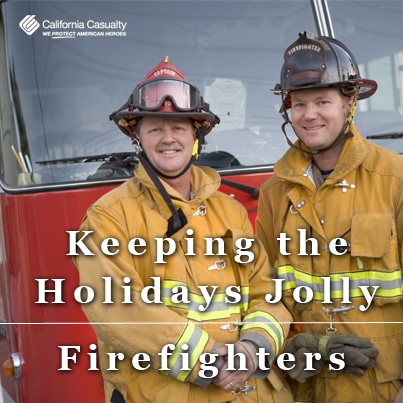
I’ve always been thankful for firefighters. They respond to fires and crashes and provide first aid when someone hurts themselves or becomes seriously sick at home. While they give selflessly to help others, the holidays can be a tough time. Accidents and fires don’t take a break and neither do the men and women in blue who will be manning fires stations or on call at volunteer departments in case they are needed. During this season of joy, let’s not forget to thank those who run towards danger while the rest of us are running away. Here are some ideas:
- Send a thank you card to your local fire station
- Thank a fire fighter in person when you see them around the community
- Bake some goodies and take them to the fire station with a thank you card
- Buy them a cup of coffee or meal if you see them at a coffee shop or restaurant
- Donate to funds that help the families of injured firefighters
- Learn CPR and other first aid
- Pull your vehicle over when you hear a siren or see a fire truck with its lights on
Another way you can make a firefighter’s day is to be fire safe this holiday season:
- Make sure real trees are fresh and needles don’t fall off when touched
- Cut two inches from the base of the trunk and immediately put it in a stand with water
- Add water every day
- Keep trees at least three feet from any heat source (fireplaces, space heaters, candles, heat vents)
- Check artificial trees for a “fire resistant” label
- Use lights that have the label of a recognized testing laboratory (UL)
- Always turn off tree lights before going to bed or leaving home
- Never use candles to decorate a tree
- If you use real candles around the home, keep them 12 inches away from anything that can burn and always blow them out when you leave a room or go to bed
- Don’t use frayed or damaged electrical cords
We know accidents happen. That’s why it’s so important that we remember our firefighters this time of year. They’ll be there if we need them.
At California Casualty, we are proud to serve firefighters with auto and home insurance designed for their professional lifestyle, with exclusive benefits not available to the general public. Call an advisor today for a free, no hassle policy review or comparison at 1.800.800.9410 or visit www.calcas.com/firefighters.
Sources for this article:
https://www.oprah.com/spirit/Thank-a-Firefighter-Every-Monday-Matters_1
https://www.nfpa.org/research/reports-and-statistics/fire-causes/holiday/christmas-tree-and-holiday-lights
https://www.nfpa.org/safety-information/for-consumers/seasonal/put-a-freeze-on-winter-fires
by California Casualty | Homeowners Insurance Info |
By Carrie Mitchell, Owner & Founder
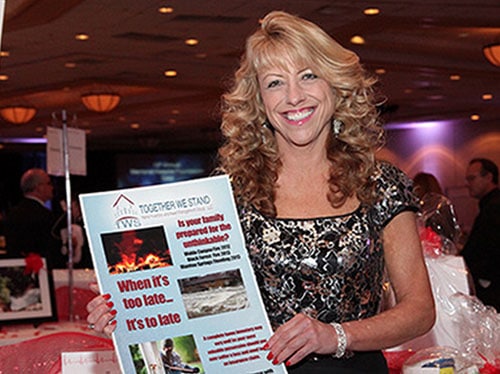
TWS Home Inventory
Knowing the despair that follows a major loss, Carrie Mitchell founded TWS Home Inventory in 2012 after helping victims of the devastation caused by Colorado’s Waldo Canyon fire in. It was in the aftermath that Carrie realized how much heartache and stress could be avoided with a professionally detailed home inventory. TWS Home Inventory is now available in California and the East Coast.
Carrie and TWS Home Inventory have been featured in Colorado media, FOX News National, FOX News Business, the Insurance Journal and the Huffington Post. Carrie will be providing us with important content about the need for a home inventory and the many ways not having one could hurt you.
California Casualty proudly insures a sector of society that knows all too well the importance of being proactive instead of reactive in our everyday lives. As educators, health care providers, fire fighters, first responders, and peace officers you see the devastating aftermath of situations outside of our control.
TWS Home Inventory and Asset Management Group was founded in 2012 as a direct result of the plight of affected homeowners in the aftermath of Colorado’s Waldo Canyon Fire. As a homeowner personally affected by this natural disaster that devastated the Colorado Springs area in 2012, I saw first-hand the trail of destruction left behind: over 350 homes destroyed and countless numbers severely damaged, 18,247 acres of forest blackened, firefighting costs alone were over $15 million, home losses and insurance claims were estimated at over $356 million two years after the fire, and many claims remain in dispute even after three years.
Although most homes were insured, the financial recovery for contents was much less than the insured structure amount and for valuables such as jewelry, guns, paintings, family heirlooms and antiques. Many of these precious possessions were simply lost forever. The simple reason for this fact is that most homeowners had no physical record or documentation of their valued possessions, let alone were even able to remember a fraction of the items lost. Now, three years later, many homeowners are still struggling to itemize their possessions leaving them with a feeling of being victimized a second time.
As a volunteer assisting these homeowners, the idea for a professionally documented home inventory service was born and TWS Home Inventory and Asset Management Group was formed. In 2013, the Black Forest Wildfire brought even greater devastation to the Colorado Springs area with over 511 homes destroyed and it was followed by the Waldo Canyon Flood.
The Root of the Problem
Once insured, a homeowner assumes that everything is covered and is totally unaware of the serious need for a documented inventory, much less the value that it adds to their insurance coverage. In my experience, most homeowners never read their policy to see what actually is and is not covered until they are in the claims process. Any loss, partial or total, requires some form of proof of ownership of contents, especially when it comes to specific valuable articles. Working with victims of loss, one thing seems to always be evident; homeowners tend to want to blame the insurance company for insufficient compensation. Unfortunately, few realize until after the fact that it is the homeowner’s responsibility prior to that loss to inform the insurance carrier of what they own to ensure proper coverage.
In the coming months we look forward to sharing with you the invaluable information learned over the past three years from homeowners affected by some of the worst natural disasters in recent years. Our goal in this series is to help educate proactive policyholders on the specific personal items you may own which need to have appraisals, floaters, riders, and endorsements not covered in a typical homeowner’s policy, because
When it’s too late….It’s too late!
You can learn more about Carrie Mitchell and free home inspection resources at
www.twshomeinventory.com.
by California Casualty | Firefighters |
By Jeff Bryan, Firefighter/EMT-1
First responders are special people. Most don’t think about money or glory; rather they are motivated by the reward of providing safety and relief, doing all they can to help others.
While some might consider first responders superheroes, just like the rest of humanity they have a very real vulnerability: mental health. Few go into the profession thinking about how the job will affect them mentally. As a public servant who cares, I feel mental health should be held to the same standard as physical fitness.
Let’s face it, we all have triggers. Whether it’s daily stress or the horror of what first responders encounter at a fire, automobile crash or domestic violence, it affects us. We mostly click into survival mode, pushing the pain and gore into a corner of our conscious, reacting to the situation with as little emotion as possible. Seeing repetitive tragedies is hard on anyone and it takes a toll. Those emotions can and do resurface and we can react in a couple of different ways. Some find positive ways to cope, others cope in self-destructive ways. I am urging all of us to be aware of “triggers” that warn someone is having trouble: they are quick to anger, suffer depression or exhibit self-destructive behavior like taking undue chances or turning to drugs or alcohol. We need to be aware that these are signs of post-traumatic stress. I thought nothing could bother me but I have since learned that no one is immune, but many will deny it. If we weren’t affected by all this, we would be narcissistic; but most first responders aren’t.
First responders are coping the only way they know how. They see and experience things that most others don’t. Here’s the problem; we must address the issue but most public servants are terrified to seek help. Why?
Many are fearful of persecution and losing employment. Those who admit they need help are often looked upon as mentally weak and “damaged.” While there has been a shift of thought in this area, too often admitting that the job is getting to them leads to castigation and forced retirement.
I have seen my fair share of tragedy and I am the first to admit it affected me. I was always happy-go-lucky, but the job has changed me. I realized I couldn’t do this on my own so I decided to get help. I have been seeing a psychotherapist for ten years. At first, I was very embarrassed. Now, I want to help others get the help they might need too. Three years ago, I invited a mental health professional to talk to our staff members. The turnout was not that great and I was hurt. I was told, “Jeff, it went well and we will come back. We touched a few and it made a difference.”
I learned help can come in many forms whether it be a support group, a church pastor, a trusted friend, your partner or someone on your crew. It’s time we put this on the table and say enough is enough, otherwise more public servants will just walk away from the job, self-medicate or commit suicide. Personally, every suicide I read about hurts me. I lost a cousin to suicide. He was a very prominent surgeon, he was my age, and it devastated my family.
I will offer one other piece of advice: use exercise and hobbies to deal with stress. Don’t let your job define your life. I find climbing is the one sport that lets my brain rest. I can only think about the rock or ice, the route, and the next move; my mind is free of everyday noise. I also actively pursue therapy and I talk with my wife. Many I know have used Eye Movement Desensitizing Reprocessing (EMDR) to treat PTSD. Whatever works for you – bowling, bike riding or hitting the gym – get going and help your mind through physical activity.
I hope writing this article will make more of us stop and pay attention. Know the warning signs: loss of interest in activities, self-medication, poor hygiene, isolation and depression or anger. Other signs are a change in one’s empathy and compassion. Those of us working as first responders need to notice those on our crew who might complain when the tones drop if they suffer from night terrors or even cry; it’s a sign our brother or sister needs help. We need to show empathy and compassion to each other and extend a hand. Let’s also not forget our retired or disabled public servants. Call and invite them to the station for a meal. Make time for them. Too many of our brothers and sisters are getting divorced and committing suicide. Let’s change the stigma and turn around the statistics.
Health and wellness must include taking care of our public servants’ mental health. It’s a concern for all of us, no one can do it all themselves. We can listen and offer advice, but if we try to become everyone’s problem solver we end being affected ourselves. We need to change the culture and make professional help available. Our leaders sometimes forget about life in the trenches. I don’t blame them; they most likely have dealt with the same issues but now they fight different battles. Their concerns are budgets, staffing, equipment upgrades, etc.
Slowly, more of the public safety leadership is addressing the issue of PTSD and the mental health of their crews. I urge more of those leaders to make a commitment to mental health. Please lobby to bring this issue to the forefront before you read about one of your people doing something rash. A proactive mental health program is also needed to reduce PTSD and worker burnout.
Jeff Bryan, Firefighter/EMT-I
Jeff Bryan is a firefighter who doesn’t let adversity keep him down. Jeff returned to full time work in March 2015, just slightly less than a year after his right leg was amputated below the knee. Jeff, who is a firefighter and EMT Intermediate with the Ute Mountain Fire Department in southwest Colorado, refused to let the amputation keep him down. He was released from the hospital on his 50th birthday. He says there were two ways to go: give up and feel sorry for himself or push forward and beat it – he chose to move beyond and conquer it.
As soon as he was able, he started bicycling, ice climbing, paddle boarding, swimming and yoga. As far as anyone can determine, Jeff is the only firefighter in Colorado to return to fulltime active duty after a leg amputation. Jeff does not want to be known as the firefighter who lost a leg, but the guy who works hard to stay in shape and be the best EMT/firefighter he can.
Jeff provides insight and commentary on issues facing firefighters, EMTs and other first responders.
by California Casualty | Safety |
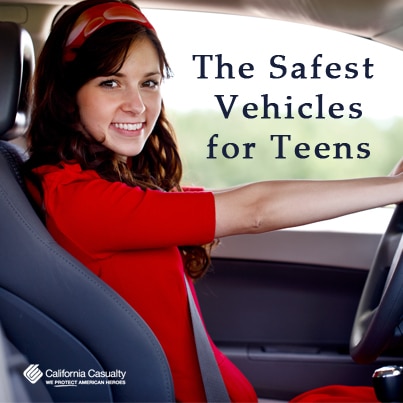
Protecting our children is a concern for every parent. For many of us, how to keep our kids safe once they get a driver’s license is a real dilemma; we want the safest vehicle that we can afford but often our budgets are limited. Thanks to the Insurance Institute for Highway Safety, finding a safe vehicle at a reasonable price is a little easier.
Using crash test data, the IIHS has released their latest list of recommended vehicles for teen drivers. There are about 150 vehicles on this year’s list with the majority of them costing under $10,000. All of the “Best Choice” vehicles have good ratings in the Institute’s moderate overlap front, side, roof strength and head restraint tests, and if they were rated by the National Highway Safety Administration they had 4 or 5 stars. For the first time this year’s list also included pickups.
The Best Choices were broken down by size, model year and price. The following are the top three in each category (except pickups which only had two):
Large cars:
- Volvo S80, 2007 and newer (price $5,800)
- Ford Taurus, 2010 and newer (price $10,900
- Buick LaCrosse, 2010 and newer (price $11,300)
Midsize cars:
- VW Jetta Sedan and Wagon, 2009 and newer (price $5,600)
- Volvo C30, 2008 and newer (price $7,000)
- VW Passat Sedan, 2009 and newer (price $7,300)
Small SUVs
- Honda Element, 2007-11 (price $6,700)
- VW Tiguan, 2009 and newer (price $7,900)
- Subaru Forester, 2009 and newer (price $9,000)
Midsize SUVs
- Volvo XC90, 2005 and newer (price $4,600
- Subaru Tribeca/B9 Tribeca, 2006 and newer (price $6,000)
- Dodge Journey, 2010 and newer (price $8,700)
Large SUVs
- Chevrolet Traverse, 2011 and newer (price $13,500)
- GMC Arcadia, 2011 and newer (price $15, 400)
- Buick Enclave, 2011 and newer (price $16,100)
Minivans
- Dodge Grand Caravan, 2012 and newer (price $11,600)
- VW Routan, 2012 and newer (price $11,800)
- Toyota Siena, 2011 and newer (price $13,200)
Pickups
- Toyota Tundra Crew Cab (double cab), 2007 and newer (price $12,200)
- Ford F-150 Crew Cab (super crew), 2011 and newer (price $16,800)
The list has a secondary tier of “Good Choices” priced under $10,000 that have less than perfect crash test ratings.
*See the entire list of recommended used vehicles for teen drivers here.
The IIHS also urges parents who don’t find a suitable vehicle from the list to seek a midsize or larger car, SUV or minivan with the most safety features they can afford. They also recommend:
- Young drivers should stay away from vehicles with high horsepower
- Bigger, heavier vehicles protect better in a crash (no minicars are small cars made their list)
- ESC traction control is a must
Keep in mind, adding a teen driver will increase your auto insurance rates, in some instances more than doubling them. Here are some tips to help manage those insurance costs for teen drivers:
- Purchase cars that have modern safety features
- Take advantage of good student discounts
- Enroll in a defensive driving course
- Try to cut their driving miles by carpooling or using mass transit
- Stick to lower horsepower vehicles
- Find an insurer who treats teens as responsible drivers
California Casualty also understands what it is like to have a new driver. Like parents, we have a commitment to the safety of teen drivers. We’ve partnered with law enforcement agencies, safety groups, educators and concerned parents to create and fund Impact Teen Drivers, an intensive campaign to inform young drivers about the dangers of distracted or reckless driving. The nonprofit provides training and powerful tools to help engage teen drivers and change their attitudes behind the wheel.
Every young driver should have the best insurance possible. California Casualty offers some of the best teen driver rates in the industry, along with good student discounts. Make sure your student driver is fully protected by calling a California Casualty advisor today and talking through your options at 1.800.800.9410 or by visiting www.calcas.com.
Sources for this article:
https://www.iihs.org/iihs/sr/statusreport/article/50/8/1
https://www.calcas.com/impact-teen-drivers