by California Casualty | Auto Insurance Info |
We wouldn’t allow our children to play with an unsafe toy, nor would we use a household item that was deemed dangerous. But, when it comes to our autos and trucks, many Americans continue driving one that has been recalled because of a safety concern.
It’s More Than You Might Think
The statistics are a bit unsettling – the number of recalled vehicles reached 51 million in 2015, second only to 2014’s record of 60 million vehicles.
What do you need to be worried about?
Auto experts say the bulk of the recalls were for faulty airbags, which have been linked to injuries and deaths. However, other recalls were for hazards involving steering, cruise control, engines and seat belts. These failures have led to sudden loss of control of the vehicle, parts failures in a crash, or caused vehicle fires.
Many Are Not Getting Fixed
Despite a major effort by automakers, only 75 percent of vehicles that might have issues are being looked at or repaired.
And that’s the concern; a recent Carfax survey found that tens of millions of vehicles that have been recalled the past few years have never been fixed. By their estimate, one-out-of-five vehicles on the roads today is in need of a repair for a defect. Even more troubling is that the type of vehicle with the highest rate of unfixed safety issues is a family-owned minivan. SUVs and pickup trucks are a close second and third. Often, this means the drivers of those cars or trucks, maybe someone you know, is at significant risk if a part should fail.
So Why Wouldn’t Someone Get the Fix?
There are many reasons why drivers aren’t getting defective vehicles to a dealer or mechanic:
- They are not aware of the recall
- They worry it will take too much time or cost too much
- They just don’t care
- Recall notices are often mailed to an old address
So Has Your Vehicle Been Recalled?
The government maintains an excellent website where you can check, for free:
https://www.safercar.gov/CheckForRecalls
If you find your vehicle on the recall list, safety groups recommend that you contact the car dealer immediately to set up an appointment to have it looked at. Keep in mind, you should not have to pay for any parts or labor because of a recall. Not all vehicles may need a fix, but finding out will bring you peace-of-mind. And, if you think your vehicle has a defect, but hasn’t been recalled yet, save any receipts; you should be reimbursed if the recall occurs later.
What Does a Recall Mean for My Insurance?
While driving a recalled vehicle shouldn’t affect your insurance, the quicker you have it checked out or repaired, the safer you and others will be.
However, you should contact your insurance company if the dealer gives you a loaner car while yours is being repaired; you’ll want to make sure you have enough coverage if it’s more valuable than your vehicle.
It’s also a good idea to check your auto insurance to make sure you are fully protected and that you are getting all the discounts you deserve. Call a California Casualty advisor today for a free policy review or comparison at 1.800.800.9410 or visit www.calcas.com.
Sources for this article:
https://www.nhtsa.gov/About+NHTSA/Press+Releases/nhtsa-launches-safe-cars-save-lives-campaign-01212015
https://ohsonline.com/articles/2016/01/22/51-million-vehicles-recalled.aspx?admgarea=news
https://www.edmunds.com/car-safety/recalled-but-unrepaired-cars-are-a-safety-risk-to-consumers.html
https://www.insurancejournal.com/news/national/2016/02/11/398362.htm
by California Casualty | Nurses |
Most of us love to get the morning (or evening if you work shifts) started with a good cup of coffee or tea. As you go through your day, have you noticed just how many mugs have a slogan or saying on them. It seems that what’s on our cup often gives a glimpse of who we are and what we think.
After doing a little research, we’ve assembled a list of some of the best sayings we’ve found on nurse’s mugs:
- Nurse: the first person you see after saying “hold my beer and watch this”
- How I take your temperature is directly related to how nice you are to me
- On a scale of 1 to 10, rate the pain of coming to work
- NURSES: We can’t fix stupid, but we can sedate it
- Caffeine PO Q4H PRN
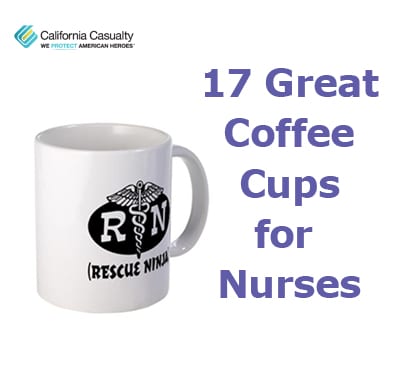
- RN (Rescue Ninja)
- I’m a Nurse, what’s your superpower
- What happens in clinicals stays in clinicals
- Yes I’m a nurse – no I don’t want to look at it
- Behind every stable, well-adjusted nurse….is a patient waiting to change that before the shift is over
- DO NOT make me use my nurse voice
- Nurses are here to save your butt not kiss it
- Don’t mess with me, I’M A NURSE: I get paid to stab people with sharp objects
- I’ve seen it, smelled it, touched it, heard it, stepped in it – Retired Nurse
- I hate being sexy but I’m a nurse so I can’t help it
- Do us a favor, stop watching Dr. Oz
- Run, the Joint Commission is coming
What’s on your favorite mug? Feel free to share it with us.
And, just like a comforting cup of hot coffee, California Casualty is a perfect complement to your day. We’ve been protecting American heroes for over 60 years providing auto and home insurance matched to your professional lifestyle. That means these exclusive benefits not available to the general public:
- Waived or reduced deductibles for vandalism or damage to your vehicle parked at work
- Rates guaranteed for a full year (not six months)
- Free identity theft protection with each policy
- Multiple payment options including EZ Pay and holiday or summer skips
- Superior customer service satisfaction rating – 99 percent with claims satisfaction of 96 percent
by California Casualty | Educators |

Wouldn’t it be nice if we could all attend the Consumer Electronics Show (CES) in Las Vegas? We could see the vendors showing off new interactive watches, the latest in cell phones, driverless cars, home WiFi based appliances and new technological wonders that can be applied in schools.
Yes, it would be nice to get super-geeked and tech-overloaded, but it’s just not practical. The second half of the year has just begun and there are classes to manage, tests to grade and new projects to challenge students.
If you are an educator, there is good news; Leila Meyer, an education tech writer went to the show. Here are the 10 Products From CES that she predicts will have the most potential to make it to the classroom:
- DAQRI Smart Helmet – designed for industrial workers, the helmet brings a mixed reality interface with the latest technology for 4D virtual reality applications that can be used in the classroom
- Kodak’s Super 8 Revival camera – designed for a new generation of video and film makers that has many applications for students and lessons, using actual film to deliver texture and vivid color, but with a digital transfer once it’s processed
- Klaxoon Cross-Device Learning Platform – Klaxoon developed a collection of tools designed to support online, interactive learning activities for any mobile device using private WiFi and Cloud storage platforms
- Samsung Galaxy TabProS – a two-in-one tablet that is small, lightweight and shareable in the classroom
- Lenovo AirClass Interactive Virtual Classroom – the name says it all, a dashboard that is accessible for teachers and students that can track a student’s engagement utilizing emotion-analyzing software
- ASUS C202 Chromebook for Education – specially designed for the abuse that comes from multiple hands in the classroom, it features wraparound rubber bumpers with reinforced corners, spill-resistant keyboard, scratch-resistant finish and shockproof solid-state drive
- Panasonic Rug Speakers – a prototype unveiled that can be built into the carpet with controllers that can direct sound toward or away from specific people with potential for libraries and informal learning spaces
- Hanvon Pentech ERT Technology – a pen that works with all-in-one touchscreen TVs, the pen uses electromagnetic resonance touch (ERT) technology that gives more accuracy and control when writing or drawing on a touchscreen display
- XYZ Steam – 3D printers specifically designed for education with applications for science, technology, engineering, arts and math (STEM) courses
- XYZmaker – 3D modeling app designed to make 3D printing technology faster and more accessible
But having and using the latest technology for technology’s sake may not get the results many educators desire. It’s important to put it into a context of learning, as the tech-instructor at Meyer Elementary School in Lexington, Michigan found out. Jeff Dahl is teaching technology through various content areas, presenting it as something purposeful, connected to learning and relevant to real-world situations. He recommends:
- Making it applicable to other class assignments
- Don’t do it alone, collaborate with other educators
- Embrace discomfort because students adapt quickly
- Apply the SAMR Model with four levels
- Substitution – technology acts as a direct tool substitute with no functional change
- Augmentation – technology acts as a direct tool substitute with functional improvement
- Modification – technology allows for significant task redesign
- Redefinition – technology allows for the creation of new tasks previously inconceivable
- Put tech integration in action
While there are many benefits to integrating new technology into the classroom, often times, the cost is out of reach for many school districts. That’s why California Casualty created the $2,500 Academic Award, to help educators purchase the materials and gadgets they need to help their students. Give your students the advantage they deserve, apply now for the California Casualty Academic Award at www.calcasacademicaward.com.
Sources for this article:
https://thejournal.com/Articles/2016/01/07/10-Products-From-CES-That-Will-Impact-the-Classroom.aspx?Page=1
https://www.edutopia.org/practice/tech-literacy-making-it-relevant-through-content-learning
by California Casualty | Auto Insurance Info |
It’s one of those bitter cold days. As you head out to start your car, you’re conflicted about just how long you should warm it up before you drive off. If you are like me, your dad or grandfather may have told you that it was best to let it run a few minutes to make sure the engine was properly lubricated and enough gas was getting into the engine. But a lot of us have also been hearing that’s no longer necessary. In fact, how long anyone should warm their car has been the topic of national auto call in shows and many automotive blogs and articles.
The bottom line is that times have changed and the advice to warm the car a few minutes is apparently no longer valid. The modern answer is that warming your vehicle (unless it’s a diesel) wastes gas, pollutes the air and may actually be bad for your engine, not to mention illegal in many states if you leave it unattended. Here is what the experts are saying.
First, modern fuel injected vehicles adjust to the cold and don’t need warming. The idea of warming a vehicle is a throwback to cars and trucks that had carburetors.
Second, modern oils and lubricants are now designed to maintain their viscosity even in abnormally cold weather. The days of warming the oil to coat important moving parts are over.
Third, it now only takes 10 to 30 seconds to warm a car or truck.
Fourth, the engines in most autos actually warm quicker when they are being driven. Idling actually works the engine and its components harder than when it is moving.
Fifth, idling costs you money in wasted fuel. Unnecessarily running your vehicle for just a few minutes a day can add up to hundreds of gallons of gas.
Sixth, warming the car in a garage can be deadly. Even if the garage door is open, dangerous carbon monoxide can seep into your home which can cause serious health problems or even death.
Seventh, idling engines produce more pollution. Nobody wants to breathe that stuff in.
Now, that we know it’s not a good idea to over-warm your car, let’s not forget the places where it’s illegal to leave it running unattended. Colorado, Maryland, New Jersey, Ohio, Rhode Island, South Carolina, Texas, West Virginia and Wisconsin have passed so called “puffing” laws, fining owners of unattended cars left running. Cities including New York, Minneapolis, Salt Lake City and Reno have also enacted ordinances against cars left idling. The only exception is if you have a remote starter and the car remains locked. That’s because it’s too easy for criminals to climb in and steal it.
The National Insurance Crime Bureau estimates that a vehicle is stolen every 33 seconds; many of those were cars or trucks that were left running or had the keys left in them. That adds up to 6.4 billion dollars, which we all pay for in higher automobile insurance rates.
To help prevent auto theft, the NICB advises to:
- Never leave your vehicle running unattended
- Always lock it
- Never leave any keys in the car, even a spare set
- Always part in well-lit, high-traffic areas
- Get windows, doors and fenders etched with the vehicle identification number (VIN)
- Consider installing a tracking and recovery device
Another way to protect your vehicle is with insurance. Don’t forget to purchase comprehensive coverage in case it catches fire, it’s damaged by a falling tree, or someone breaks in or steals it. Before that happens, contact a California Casualty advisor today for a no hassle policy comparison or review at 1.800.800.9410 or visit www.calcas.com. It just might warm your day.
Resources for this article:
https://knowhow.napaonline.com/tips-for-warming-up-your-car-on-a-cold-morning/
https://www.autoblog.com/2009/04/08/warm-up-car/
https://www.esquire.com/lifestyle/cars/a9123/warming-up-car/?utm_content=8742496&utm_medium=social&utm_source=twitter
https://www.nicb.org/newsroom/news-releases/theft-stats-with-keys-left-inside-vehicle
https://www.wnd.com/2014/01/cold-shock-warming-up-your-car-illegal/
by California Casualty | Auto Insurance Info |
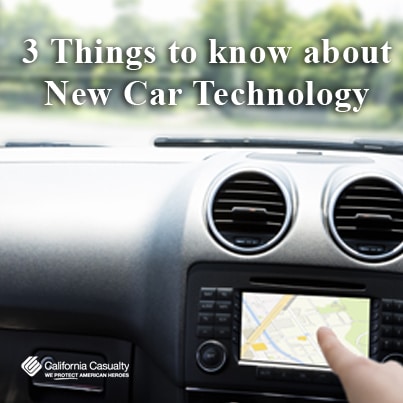
Is the new technology in your car helping you or hurting you? California Casualty is very interested in making sure your vehicle is safe for you and your family.
The National Highway Traffic Safety Administration says the technology could lead to an era of virtually zero highway deaths and could cut traffic congestion, suggested Mark Rosekind, an administrator for NHTSA. David Sargent, vice president of global automotive at J.D. Power states that automakers are focusing on giving consumers the new features and technology they want. The mechanical problems that are traditional have vanished. Thanks to the newest vehicles of today, the quality is better than ever.
Some of the latest features include:
- Advanced Backup Cameras– Being able to see all angles while in reverse
- Automatic Steering- Helps keep the vehicle in the lane, should you become distracted.
- Smartphone Vehicle Management- Locates the car, starts the engine, or call for roadside assistance.
- Self-Parking Systems- System uses sensors, cameras, and other technology to automatically park the vehicle.
But could they be more harm than good? Recent smartphone technology in these cars could enhance distracted driving. Kim Komando, a digital expert, also says that the new computers in cars can make them easier to hack. How safe is it if you have a car that can drive itself? Who is to blame if in an accident? Is it the driver or manufacturer?
Here is a list of actions to take before purchasing a vehicle with new technology.
- Research the vehicle– The more you know about the vehicle will reduce the stress of buying.
- Ask the seller- Ask the seller, whether it be private or dealership, to see all the features that the car can do before purchasing.
- Check your coverage– Check in with your insurance company to see about accidents caused by technology, and how it affects your policy.
Getting a new vehicle is exciting, that is why it is important to know the facts of serious purchasing.