by California Casualty | Educators |
Our Education Blogger is a public school teacher with over a decade of experience. She’s an active NEA member and enjoys writing about her experiences in the classroom. Cooperative learning strategies
Tired of using the same cooperative learning strategies over and over again? Ditch think-pair-share and jigsaw and try some of these fresh, meaningful group learning strategies.
Four Corners (TeachingWithSimplicity.com)
- Students are given four choices. 2. Students record their answers. 3. The teacher designates one corner for each choice. 4. Students travel to the appropriate corner. 5. Students pair up and discuss answers.Check out these examples:
- Just for Fun: What is your favorite flavor of ice cream?
- Science: Provide students with four animals. They choose which one to represent then give 2 to 3 examples of the animal that they chose.
- Math: Provide students with four angles: Straight, obtuse, acute, or right. They think of a real world object that includes the angle.
- Language Arts: Students decide what season of the year they think is the best. Then support their opinion with details.
- Reading: Decide on four genres you want students to focus on. After students pick their genre, they are to write the title of 2-3 examples they think fit the genre. Discuss in corner.
- Social Studies: Give the name of four Native American Indian tribes. Students share what they wore, used as weapons, lived in, etc.
Cooperative Graffiti (TeachHub.com)
Another great brainstorming technique to try is cooperative graffiti. This strategy requires students to think about a topic and write down as many ideas as possible using different-colored pens. To start, divide students into small groups and give each group a large, butcher block piece of paper and a variety of colorful pens. Write down a broad topic on the front board, and on your command “Go!”, instruct students to write down as many ideas as they can that correlate with the topic you wrote on the board. Once the time is up (about 5-10 minutes), then have students try and organize their colorful ideas into categories.
Round Table or Rally Table (Oregon Department of Education)
These are simple cooperative learning structures that cover much content, build team spirit, and incorporate writing. The roundtable has three steps to it. In the first step, the teacher poses a question that has multiple answers. Step two, the first student in each group writes one response on a paper and passes the paper counterclockwise to the next student. Finally, in step three, teams with the greatest number of correct responses gain some type of recognition. This type of cooperative learning can easily be used in the science classroom. For example, the students may be asked to write as many reptile names as they can. At the end the group with the most reptiles written down is rewarded. (Example: A teacher displays a picture and asks what are various food chains found within the ecosystem of the picture. One student writes a food chain on a piece of paper then passes the paper to other members of the team for them to write a food chain that they see in the picture. Students continue to pass around the paper until the teacher stops the activity or until a group runs out of answers.)
Carousel (University of Albany)
In this activity, students are broken into groups of 3-4 and the teacher places chart paper around the room with different questions on them, related to a certain topic. This lesson can be done before starting a new unit to activate prior knowledge, during the unit, or at the end of review. Each group starts at a different poster and is given a different color marker to write with. The marker travels with the groups around the rooms, and each group has 1-2 minutes to answer the question on the chart paper. They then rotate around the room to the next poster and repeat the process. You may want to try to get each group member to write their ideas down on the paper so that each student’s ideas are evident on the paper. When every group has written on each piece of paper, the class comes together for a whole class discussion and shares what is written on the posters.
Writearound (ColorinColorado.org)
For creative writing or summarization, give a sentence starter (for example: If you give an elephant a cookie, he’s going to ask for…). Ask all students in each team to finish that sentence. Then, they pass their paper to the right, read the one they received, and add a sentence to that one. After a few rounds, four great stories or summaries emerge. Give children time to add a conclusion and/or edit their favorite one to share with the class. Cooperative learning strategies
Forced Debate (TeachHub.com)
This strategy requires students to use their communication skills to work within a group. Here’s how it works: The teacher writes a proposition on the front board, such as “Should there be a vending machine in the school cafeteria?” then the students who agree move to one side of the classroom and the students who disagree move to other side. Once students are on one side of the classroom, that is now their group. The teacher then forces them to debate the opposing side that they have chosen. This strategy really utilizes students’ critical thinking skills and forces them to really think about the question as a whole in order to argue for the opposing side rather than what they really feel about the question.
Snowball (AlgonquinCollege.com)
Flip chart papers are posted around the room. Each page has a different question to respond to, sentence to complete or other prompt for input. Learners are divided into pairs or small groups (up to 6). Each pair or small group is given a marker. Each group is situated at a different flip chart page and asked to write their responses on the sheet in front of them. The facilitator calls “snowball” and each group rotates clockwise. They read what the previous group has written and add new ideas or different views. The process continues until each group has rotated to all pages. The facilitator leads a debriefing session. You may have each group summarize the page that they finish at and suggest possible implications, applications etc.
Cooperative Learning is beneficial to students. Students have a responsibility to the group and to themselves. It encourages positive student interactions. Students also gain practice using social and collaborative skills. At the end of each cooperative learning activity, conduct discussions with students. You might ask students to name one thing they learned, how they felt working in a group, or how they might improve their group work.
We’d love to hear from you! Tell us your favorite Cooperative Learning Strategies!
This article is furnished by California Casualty, providing auto and home insurance to educators, law enforcement officers, firefighters and nurses. Get a quote at 1.866.704.8614 or www.calcas.com.
by California Casualty | Educators |
There is a podcast for just about everything these days. Podcasts for teachers or education professionals is no exception. Whether you are looking for support from other real-life teachers, want to brush up on your skills, or have a good laugh from someone who “gets it”, there’s a podcast for that. You can also find podcasts for teachers that cover new activities and technology you can incorporate into your classroom. Or, if you want something that combines everything there is to know about teaching all under one roof, the perfect podcast is just a few clicks away.
It’s no secret that teachers are busy, especially at the beginning of the school year. Podcasts are the quickest way to learn new information from other professionals in the industry. Just pop in your earbuds and press play. Listen while you are grading papers, at the gym, doing chores around the house, or even in the car; and start learning!
Here are 8 great podcasts for teachers:
1. The 10 Minute Teacher Podcast
Vicki Davis aka @coolcatteacher on social media talks with educators from around the world, for 10 minutes a day- 5 days a week. Learn about tips they use in their classrooms and how they overcome challenges for their students.

2. The Cult of Pedagogy
Jennifer Gonzalez talks teaching strategies, classroom management, educational reform, & new technology. Additionally, she interviews fellow educators, administrators, parents, and even students about their schools.

3. TED Talks Education
These podcasts are delivered in short, by some of the world’s greatest educators, researchers, and community leaders. They share their methods in teaching education and their vision for education in the future.
4. The Google Teacher Tribe Podcast
Matt Miller and Kasey Bell give G- Suite and other Google tools advice and ideas designed for K-12 educators.
5. Teacher Talk
Hosts, Johanna and Jared, discuss methods on how to balance being a successful teacher in the classroom while still having a life. This podcast is guaranteed to make you laugh.
6. The Creative Classroom
John Spencer shares tools, strategies, mistakes, and stories to help teachers to boost creativity in their classrooms.
7. Truth for Teachers
Angela Watson speaks life, encouragement, and truth to educators to inspire them and get them ready for the week ahead.
8. Crying in My Car: A Podcast for Teachers
Comedian and fellow teacher, Devin Siebold, jokes about his life as a teacher/comedian, the woes of teaching, and the everyday thoughts that teachers have that they never speak out loud. This podcast is sure to bring you to tears with laughter. **Although listen with caution, this podcast could be considered “on edge”. Some topics discussed may be considered inappropriate for some audiences.**
Happy listening 🙂
This article is furnished by California Casualty, providing auto and home insurance to educators, law enforcement officers, firefighters, and nurses. Get a quote by calling 1.866.704.8614 or visit www.calcas.com.
by California Casualty | Educators |
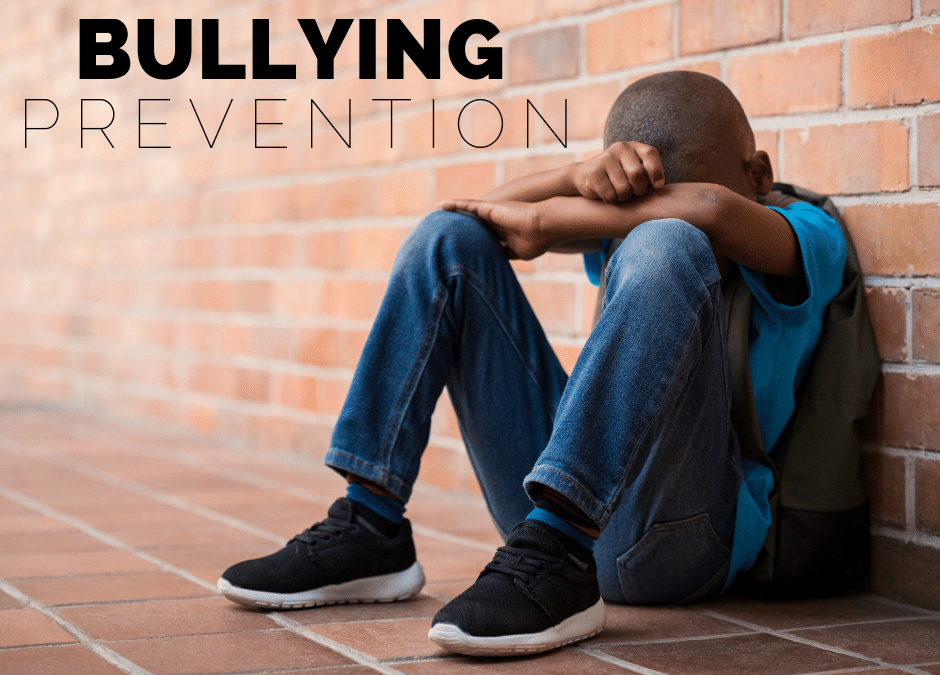
With all of the new technology and apps that are continuously being developed, it is easy for bullying to go unnoticed by parents and teachers. According to the American Federation of Teachers, 15-25 percent of all American students are bullied to some degree; 40 and 50 percent of that occurs in the form of texting and cyberbullying. Teaching bullying prevention and social media etiquette to students at a young age is key to combat bullying and cyberbullying.
Students that are victims of bullying are prone to suffer from loneliness, anxiety, and depression. They will likely carry this with them throughout their lives. Those who are bullied have also proven to perform at lower academic levels than their peers. That is why it is important for educators to be a part of the mission to combat bullying in schools. Bullying prevention
Here are some ways teachers can help prevent and fight bullying in their classrooms.
1. Maintain Consistent Classroom Management
To create a classroom environment of respect and responsibility invite students to help establish the classroom rules. Engage in a discussion about do’s (ex. saying please, raising your hand, using inside voices) and don’ts (ex. bullying, cheating, stealing). Keep the expectations of these rules clear, simple, and explicit. It is important to be consistent in enforcing these rules and follow through with consequences immediately if the rules are broken.
2. Have a Lesson on Bullying and Social Media Best Practices
Early in the year dedicate a lesson to bullying that shows first-hand the effects of bullying and cyberbullying. Go over best practices on how to avoid and handle cyberbullying and what to do it if is happening to them. Let students know bullying will not be tolerated, and reinforce the consequences of what will happen if someone is being bullied in your class.
3. Get the Entire Story & Act Immediately
If bullying does happen, be thorough in your “investigations” of the situation. Separately, talk to each student involved. Listen, don’t blame or assign labels. Hold all parties, including bystanders, accountable for their actions or lack of action. Once you know the full story, take action immediately. If you don’t, you are sending the message to all involved that the behavior is acceptable.
4. Follow Through
Check up on students who have struggled with a bullying situation: victims, witnesses, AND bullies. Ongoing support of students who have been involved in a bullying situation can help minimize, or prevent, the effects of bullying in the future.
5. Create a Safe Classroom Environment
It is important to create a classroom environment that is welcoming, safe, and supportive. Students should be aware of your willingness to listen and help them if they are in a situation where someone is bullying them in school or online.
6. Be Aware of School and District Bullying Policies
Brush up on your district and school bullying policies and procedures. When you know the rules, you can feel confident implementing them.
7. Open Up the Lines of Communication
Consistent communication with parents and families is an important tool in bullying prevention. When students are aware that their parents are only an email or phone call away from their teacher, they are less likely to commit acts of bullying.
8. Get Other Teachers Involved
Bullying isn’t limited to just one classroom or area in a school building. With your colleagues, talk about the issues in your own classroom and listen to other teachers as they discuss their specific challenges. As a team, or building, you can identify the needs of specific students, or areas of the building, that may need additional supervision/monitoring.
9. Learn About It
Not quite sure what to do with a bully or how to speak to a victim? Seek out professional development or courses that will help you learn about bullying. There are also many free resources for teachers, like the APA bullying module for teachers listed in the resources below.
10. Create a Club or Group Against Bullying
Group meetings are a great way to bring up the topic of bullying and peer relationships. Expound on the topic by discussing bullying in pop culture (TV shows, movies, etc.). Have students describe the impacts of bullying and ways to solve the issues, and then try and start a no-bully campaign at your school where everyone can be involved and stand up against bullies.
For more information on Bullying in the Classroom Visit:
Educate Staff and Students About Bullying from StopBullying.gov
Printable Bullying Prevention Worksheets – a collection of anti-bullying printables from Easy Teacher Worksheets
Bullying: A Module For Teachers – from the American Psychological Association
Webisodes for Kids from StopBullying.gov
Anti-Bullying Activities and Lesson Plans from EducationWorld.com
This article is furnished by California Casualty. We provide auto and home insurance to educators, law enforcement officers, firefighters and nurses. Get a quote at 1.866.704.8614 or www.calcas.com.

by California Casualty | Educators |
Our Education Blogger is a public school teacher with over a decade of experience. She’s an active NEA member and enjoys writing about her experiences in the classroom.
Back to School Night can be overwhelming and somewhat dry for teachers and families.
Teachers try to squeeze as much information as possible into a brief period of time, while trying to meet new students and answering parent questions. But you don’t have to focus on just school business during this time; instead, have some handouts and packets ready for parents to grab, carve out a short time for some Q&A, and then start having some fun with students and their families!
We’ve compiled a list of some ideas that will have you, your students, and their parents excited about the upcoming school year. Here are 8 Simple Activities to Make Back to School Night Fun!
1. Scavenger Hunt (Angela Watson – The Cornerstone for Teachers)
Families can complete this activity while they wait for you to begin the presentation, and/or afterward while they wait to talk to you. One parent sent me an email afterward saying how much she enjoyed it because she had a purpose in walking around the room and knew what she was looking at. The scavenger hunt can end with the parent at the child’s desk, waiting for you to begin talking.
2. Guessing Games (Livestrong.com)
Guessing games add an entertaining twist while helping parents get to know the teacher and classroom better. A bulletin board display with pictures of teachers as babies or kids is a classic game option. The parents try to match the teacher with the childhood picture. If the open house happens after school starts, the kids can get involved in the game. Each child draws a self-portrait for display. Each parent tries to guess which self-portrait belongs to her child.
3. Parent Bingo (SignUp.com)
Create a BINGO card with slots full of things parents have done relating to school and have them try to get BINGO by finding other parents in the classroom that can initial off each slot. For example, one slot on the card can have “Majored in business.”
4. Name Alliteration Game (SignUp.com)
Go around the room and ask parents to say their name accompanied with an adjective using alliteration (i.e. Marvelous Miranda). After each person says his or her name, the next person has to recite every person prior to him or her and build to the chain of introductions.
5. Student/Parent Journal Entry (Angela Watson – The Cornerstone for Teachers)
The kids write on a topic such as “The Hardest Part/Best Part of Being a Kid”. They then set up the page across from that page with the title, “The Hardest Part/Best Part of Being a Parent”. The families complete the journal entry at Back-To-School night and children read them in the morning. (Have another morning warm-up for kids whose parents did not come.) This is a good activity if you use journals and workbooks a lot: it lets parents see how much work the child is doing in class, even though it may not all come home because it’s not on loose-leaf paper.
*Be aware that some parents may not feel comfortable with their own reading or writing skills or may be preoccupied with their young children or the papers you have handed them, and may not take part. I have had moderate success with this activity in that regard, but the parents who did do the journal entry absolutely raved about it.*
6. Parent Quiz (SignUp.com)
Create a small quiz relating to the designated class and have parents participate by testing their knowledge on the subject. Make it extra fun by having the students grade it!
7. Academic Games (Livestrong.com)
An academic theme to the games allows the teacher to introduce some of the concepts she’ll teach in class. If estimation is on the schedule for math class, an estimation game with objects in a jar is an option. The parents use estimation skills to guess how many of the object are in the container. For a language game, parents might receive letter tiles to make as many different words as possible using only those letters. If the teacher uses games in the classroom to teach concepts to the kids, those games can go out during the back-to-school night for parents to play.
8. Significant Item (SignUp.com)
Ask parents to look into their handbag or wallet and ask them to choose something significant to them. Then they have to share why that item is significant to them with others.
What are your tricks to get students and families feeling eager about the new school year?
This article is furnished by California Casualty, providing auto and home insurance to educators, law enforcement officers, firefighters and nurses. Get a quote at 1.866.704.8614 or www.calcas.com.
by California Casualty | Educators |
You’ve spent long hours preparing for your career in teaching, but researching, studying, student teaching, creating lesson plans, and interviewing can only prepare you for so much. Your biggest lessons will come from experience. We’ve gathered some tips to remember as you begin your teaching career.
Here are 10 things you need to know as a new teacher:
- Be organized, yet flexible, at school and at home. Situations arise that you have no control of, and that is okay. Learn not to stress when you are behind or have to modify your schedule.
- Get to know your students. You are around them more than their parents, and they look up to you as they would a parent. However, realize not everyone will like you, and that is okay.
- Build professional relationships within your school. Watch others teach, ask questions, and find a mentor. You aren’t alone in this.
- You’re the adult in the room. Carry out punishments and rewards firmly, and fairly. Earn their respect and trust, and then start building your friendships.
- Listen to advice and trust your gut. Nothing can prepare you for actually getting in front of a classroom and teaching, but you know what to do. Trust your instincts, and don’t be afraid to ask if you need help.
- Expect to make mistakes. Teachers with decades of experience are still making mistakes. Learn to cope with the fact that making a few mistakes is inevitable.
- Empathize with your students. Be patient with your students, not everyone learns at the same pace or has available resources at home.
- Never stop learning and bettering yourself. Go to conferences, stay on top of best practices, and implement new teaching strategies into your lesson plans.
- Don’t let work overshadow your personal life. Don’t burn yourself out, try and maintain work/life balance. Don’t spend too many hours at school or grading papers, it will affect you and your teaching.
- Always remember your motivation. Remember what made you get into teaching, and hang on to it when times get tough and you feel defeated.
Being a new teacher will come with its ups and downs, but knowing that you are making a difference with your students is what makes up for it. You are going to do great! 🙂
This article is furnished by California Casualty, providing auto and home insurance to educators, law enforcement officers, firefighters and nurses. Get a quote at 1.866.704.8614 or www.calcas.com.
by California Casualty | Educators |
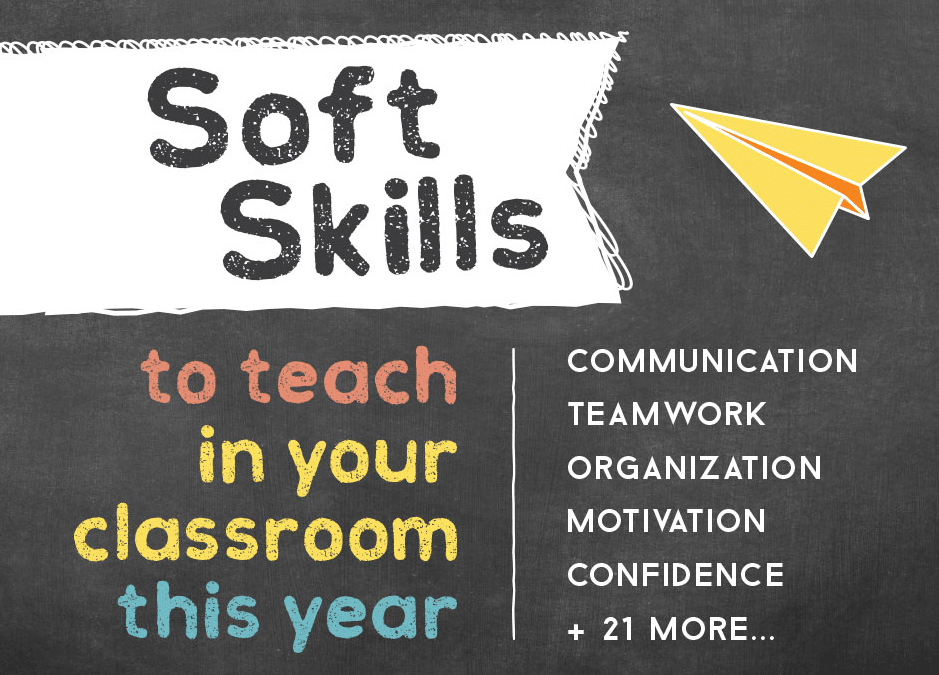
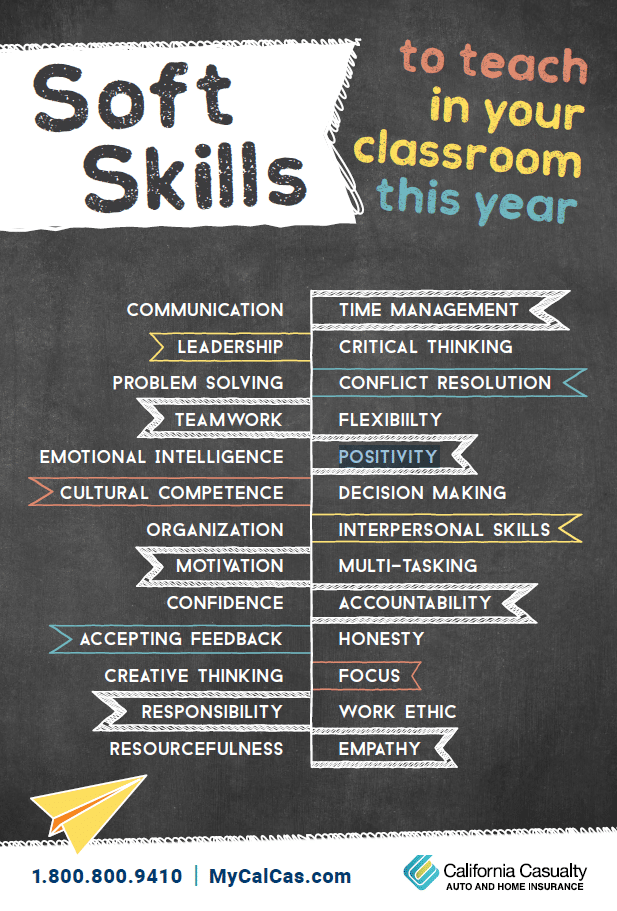
Soft Skills are very important non-academic skills that kids need to learn to help them throughout their lives. There are many ways teachers can incorporate soft skills to teach in the classroom. This can range from problem solving exercises, practicing mindfulness, to group communication with other students. soft skills printable
Download our free Soft Skills printable below. Use it to hang up in your classroom to make sure your students are continuously working on their soft skills. Additionally, you could even develop activities around each skill and have students share examples of each soft skill they use with with friends, family, and even in the classroom!
This article is furnished by California Casualty, providing auto and home insurance to educators, law enforcement officers, firefighters and nurses. Get a quote at 1.866.704.8614 or www.calcas.com.