by California Casualty | Firefighters |
Driving is part of nearly every call, and medical emergencies do not stop happening on account of bad driving conditions. When winter rolls around, most people can leave the car in the garage and stay off the roads. As an EMT you don’t have that luxury, and there are certain precautions and considerations to take. Here are some tips on how to stay safe on the road as a paramedic, from keeping the vehicle in good condition to reducing your speed.
At the station
When the temperatures are dropping and you hear that first winter forecast of the season, preparing your vehicle should be your first move. If you drive a vehicle that belongs to a department, the tires are usually well maintained, and the tread depth should be sufficient for winter driving. Even so, it certainly doesn’t hurt to check. If you are a volunteer, then it is your responsibility to check the inflation and tread depth of the tires on your vehicle.
Check that you have the appropriate level of fluids that are specifically meant to combat freezing temperature, namely antifreeze. Also, your windshield wiper fluid should be rated not to freeze, so make sure you’ve got enough. You’d hate to be flying blind out there.
Speaking of your windshield wipers and your windshield, make sure your wiper blades are soft, pliable and in good condition. Visibility is greatly reduced in inclement weather, so remember to clean your windows and windshield thoroughly between calls. Ice, snow and salt can all accumulate over time, so make sure that your headlights and emergency lights are cleared off. This ensures other motorists can see you when you’re rushing to respond. Snow and ice can also pack into your siren cones, so clear those out to make sure your siren is at full volume.
On the road
Getting your vehicle properly prepared to face the harsh environment in the event of a call is only half the battle. The rest takes place when you’re actually driving, and a main factor is ice. You don’t always see ice, so an important thing to do when you’re responding to a call is to reduce your speed and increase your stopping distance. You may tend to ignore your speed while focusing to respond as fast as possible, but you may be putting yourself and other motorists in danger.
Black ice can show up anywhere; so remember that just because you can see the road does not mean it is free of ice. Remember that bridges and overpasses freeze before the rest of the road does, so be especially careful when your route takes you over one. Ice isn’t always the culprit in winter driving, so watch out for snow and slush as well. Snow and slush make roads slippery, and you can get stuck in particularly deep snow. Don’t drive into deep snow unless you are driving a vehicle that is adequately suited for it.
Above all, be careful! With a proactive attitude and an awareness of road conditions, you’ll be able to carefully and quickly respond to any emergency calls during the winter.
Author Bio:
Cheryl Bikowski is Marketing Communications Supervisor of Gamber-Johnson in Stevens Point, WI. Gamber-Johnson is a leading supplier of vehicle computer mounts and vehicle docking stations and is a member of the Leggett & Platt Commercial Vehicle Products (CVP) Group.
by California Casualty | Educators |
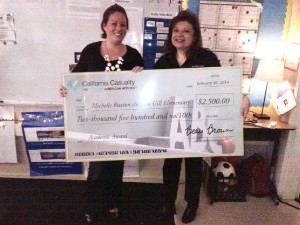
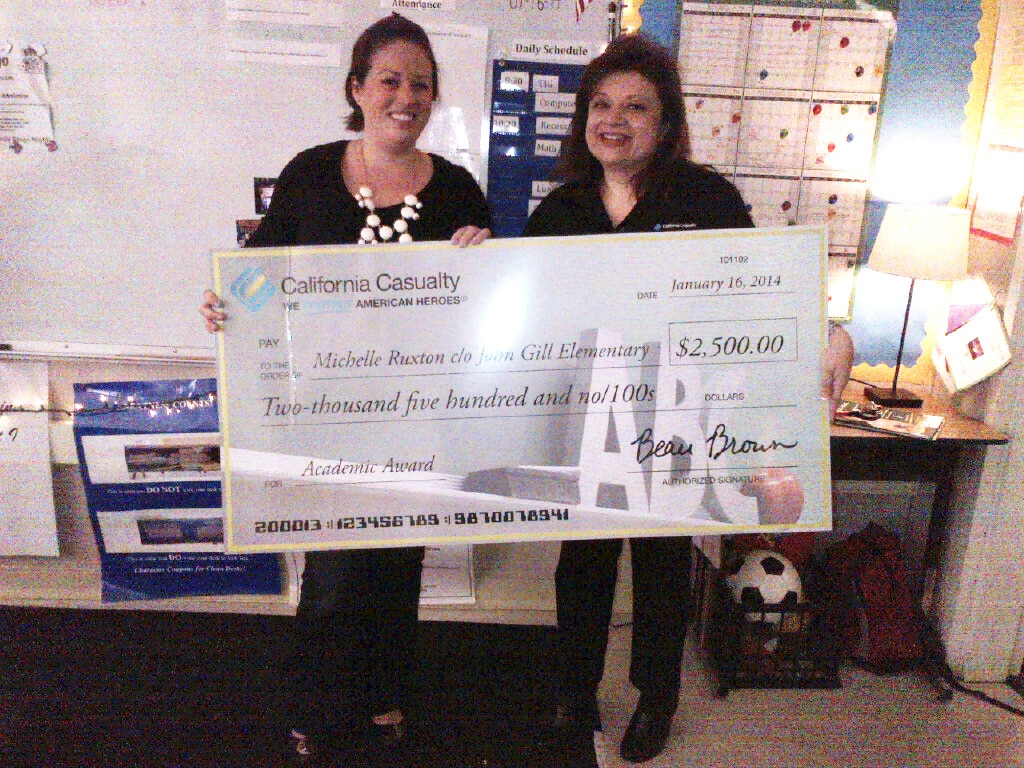
The California Casualty Academic Award was created to help defray costs that educators pay for classrooms and other instructional materials. A recent survey found public school teachers spent $1.6 billion of their own money on classroom supplies and gear in the 2012-2013 school year, with each teacher averaging $500 of their personal money.
The latest California Casualty Academic Award winner is California teacher Michelle Ruxton, who received her Academic Award check Thursday, January 16, 2014. Her name was randomly selected from more than 15,000 entries from across the nation.
Ms. Ruxton is in her second year at John Gill Elementary School, in Redwood City, California, where she teaches 5th grade. She says she will use the money to invest in a Smart Board projection system to enhance the education experience of her students by integrating lessons with fun and engaging multi-sensory curriculum.
Ruxton says she has spent more money than she cares to admit on supplies for her students and classroom. “Thank you for the award! My class and I are ecstatic,” she said.
Previous Academic Award winner, Atwater, California, high school teacher Elaine Tam, is using her California Casualty Academic Award money to fund a bus trip to the Monterrey Bay Aquarium and for school room supplies. Heidi Fortney, kindergarten teacher in Sycamore, Ohio, bought iPads for her students to use.
“California Casualty, which has 63 years of ties to public education, wants to help educators in their tireless work to educate our children. This is just one small way we can say ‘thank you’ for the dedication and sacrifice made daily on the job”, said Vice President Mike McCormick.
Entries are now being taken for the next Academic Award contest, with the winner announced April, 2014. Eligibility requires membership in the AEA, CTA, NEA (National Education Association), or referred by a current member of the state NEA affiliate or one of our other participating educator associations including: ACSA, CASE, COSA, KASA, NASA, UAESP or UASSP. Complete rules and information can be found at www.calcasacademicaward.com.
by California Casualty | Safety |
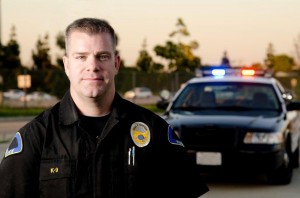
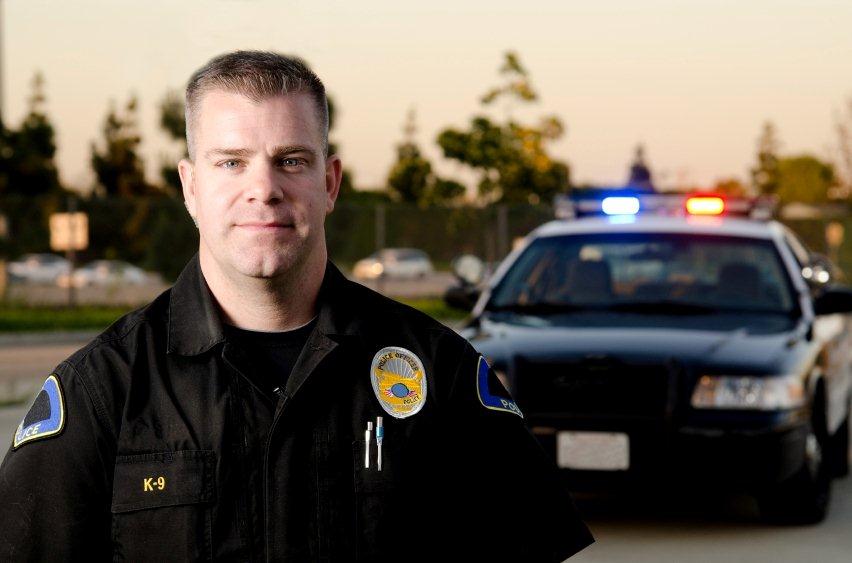
There are many dangers associated with being a law enforcement officer. Many come simply from driving. The police have to protect the public but also protect themselves by not taking risks while in or around their vehicle. Here is a roundup of eight ways for police officers to keep safe on the job.
1. Don’t drive tired: It’s been proven that driving fatigued can be as bad as driving drunk. You’re especially at risk if you work overnight; the darkness can make anyone want to doze. Recognize the warning signs and know when you need to take a break: eyes closing or going out of focus, persistent yawning, irritability and wandering thoughts, among others.
2. Wear a seatbelt: This should go without saying, but it doesn’t. Not only is it a good example for the public, it is a no-brainer for keeping officers safe on the roadways. Sadly, almost half of officers killed in vehicle accidents were not wearing a seatbelt.
3. Use GPS: 911 dispatchers can use GPS to see where officers’ vehicles are at all times. Not only does it allow for the monitoring of safe driving habits, a live map shows the dispatcher which officer is nearest to the scene of an emergency. GPS speeds up the decision-making process, saving what can be critical moments, and the operator can send an officer who can get to the incident the soonest. As always, be sure officers are trained on any new technology in the vehicle, such as GPS-enabled laptops.
4. Avoid multitasking: Police officers today are outfitted with all kinds of equipment in their vehicles, including cameras and computers. Use extreme caution if you have to use this technology while behind the wheel. Eating, drinking or having a conversation while driving can be distracting, too. If it’s not an emergency situation, stop the car and do what you need to do.
5. Wear a reflective vest: Increasing your visibility is a simple but crucial step to take when you exit your vehicle to enter the roadway or stand on the shoulder. If the situation allows, pick these locations wisely — try not to pull over on a blind curve, where other drivers have little or no chance to see you in time to slow down.
6. Keep tires maintained: The vehicle should have a light that warns the driver when tire pressure is low, but it doesn’t hurt to check it once in a while, especially when the temperature drops significantly at the beginning of winter. Check tire treads using the “penny test”: place an upside-down penny in one of the treads. If you can see the top of Lincoln’s head, your treads are wearing down and the tire should be replaced.
7. Don’t speed unless necessary: Speed can kill. The faster a car is moving, the less time the driver has to react to any obstacle. Making sudden maneuvers at high speeds leads to accidents.
8. Call for backup: If you have a feeling that backup is needed, ask for it. Don’t worry about inconveniencing other officers. You are better safe than sorry if you suspect that someone has a gun or that you will be in a threatening situation.
Author Bio:
Cheryl Bikowski is Marketing Communications Supervisor of Gamber-Johnson in Stevens Point, WI. Gamber-Johnson is a leading supplier of vehicle computer mounts and vehicle docking stations and is a member of the Leggett & Platt Commercial Vehicle Products (CVP) Group.
by California Casualty | Peace Officers |
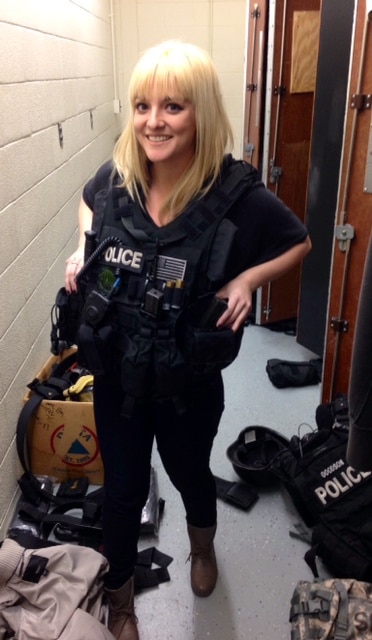
As someone from the general public, it was a true eye opener of an experience to learn what peace officers do on a daily basis. Sure, we read about stories of officers risking their lives, or watch stories on the news about those that make the ultimate sacrifice for everyday citizens, like me. This is mainly why I chose to do a ride along with Officer Joyner, with the Jefferson City Police Department.
It was a cloudy Saturday afternoon, and things seemed quiet in the station. Some officers were finishing typing reports and others on the phone with dispatch getting directions to the next call. Walking outside and getting into our patrol vehicle for the day was different for me, taking in the sight of all the patrol cars parked together.
We headed to the streets, my eyes wide open now, viewing things from a different perspective. I was being more observant than the usual drive in my car, when I’m usually focusing on everything else to be done that day. Officer Joyner was helpful in answering my questions as they came to mind, trying to figure anything and everything about what he and other officers think, feel, hear, and see while on the job. He told me about the city’s different patrol securities varying with the university in town, and the state capitol.
As the day went on, we had a few basic traffic stops for people who chose not to stop at a four way stop intersection, or to drive with expired tags. It was interesting observing what happens when the officer comes back to the vehicle after collecting your license and registration.
I asked Officer Joyner about how he got into the business of being a daily hero, protecting the city and those within it. He shared that he became interested in criminal justice in college and his passion for it has grown stronger over the years. I found the stories of Officer Joyner’s previous undercover narcotic experience fascinating as well as a brief history recap he gave of the state petitionary located in Jefferson City. Once we returned back at the station, we took a brief tour of the building. From the SWAT equipment and vehicles to the holding cells, it was a whole new world for me. I read about stories involving all of this daily, and now it puts everything in perspective.
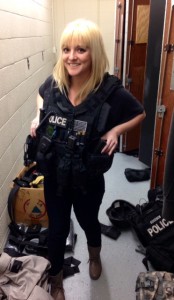
I wish everyone could have the experience that I did. Peace officers have one of the most dangerous and risky jobs, not knowing what the next day or hour could bring to them, unlike some of us who just report from a desk. I could not have thanked Officer Joyner and the other officers enough for an amazing experience, along with extending my sincere gratitude for all the other peace officers out there.
by California Casualty | Peace Officers |
With the polar vortex still roaring across the country, everyone is frantically doing their part to keep warm and safe. Abbye spent over a year writing about heroes for California Casualty, and recently had the opportunity to experience how some peace officers are willing to go above the call firsthand. This is the story in her words:
On the evening of January 6, the windchill in Ann Arbor, Michigan was around negative 35 degrees. The roads were frozen and icy as I got on Highway 94 headed to the airport. It was around 11 PM and pitch black out. Not 20 minutes into my drive, I hit a patch of black ice and crashed my truck head-on into a highway median. I quickly called 911 and about five minutes later, a Michigan State Trooper named Anthony Young arrived on the scene. Given the horrible road conditions, the inclement weather, and the exceptionally cold temperatures, I’m sure Trooper Young had a long night before he was dispatched to the scene of my accident. But you’d never guess from his demeanor. Upon arrival, he made sure I was okay and even asked about my dog- who had been in the car with me. I have never been in that serious of an accident and I was pretty shaken up and scared. Young was patient, calm and reassuring. I had hit a median and was stuck on the left side of the highway, but Young kept his lights on behind me to alert other motorists and keep me safe from another collision.
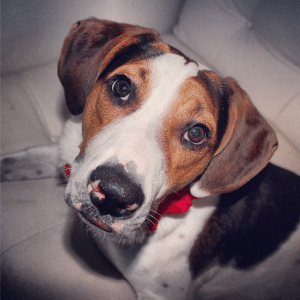
Shortly after a tow truck arrived on the scene, the driver inadvertently let my very frightened dog out of the car. My dog, Seamus, immediately took off, sprinting along the center median down the highway. I took off after him. Acting quickly, Trooper Young immediately followed alongside Seamus with his lights on, preventing him from crossing traffic and getting hit by oncoming traffic. Young even tried to cut off Seamus’ run by blocking him between the median and his vehicle, but Seamus hopped over the hood of his car, crossed west-bound traffic and ran off into the woods.
Trooper Young had already written his accident report and I’m sure he could’ve left the scene, or even told me I had to abandon my search for my own safety and his. Instead, Young got out his flashlight and started to help me look for my lost dog. His partner arrived on the scene, and the two troopers, the tow truck driver and I all walked the edge of the woods, calling for Seamus. Admittedly, I was a bit hysterical. I had just totaled my car and now I had lost my dog. Young remained completely calm and never once suggested we abandon the search.
It was Trooper Young who eventually located the spot where Seamus had entered the woods. He then used his flashlight to light the way as I followed Seamus’ trail. The windchill on Monday was around -35 degrees and there was at least two feet of snow on the ground, but Young didn’t give up. He stayed right behind me, trumping through the snow, until we found my freezing, terrified dog. By then, we were miles from the original crash site. When we found Shae, Young just laughed, patting him on the head and commenting on how much he must like a good evening run. I thanked him repeatedly for saving my dog, to which he humbly laughed and said I was lucky to have found the troopers (him and his partner) who were dog lovers.
Lucky is an understatement. I know it may seem like a little thing, helping some hysterical woman find her lost dog, but if you happen to be a dog owner, I’m sure you can appreciate what it would be like to total your car and then lose your dog. I had recently changed Seamus’ collar and knew his new one was without ID. It was dangerously cold and he had just been in a serious car accident, so I was sure he would be in serious trouble if we didn’t find him that night. I just recently moved to Michigan for school and Seamus is the only ‘family’ I have here. Losing him would have been devastating.