by California Casualty | Homeowners Insurance Info |
Springtime is tornado season in the United States. Many people have been lulled into false sense of security by the relatively slow start this year. But once again Mother Nature flexed her muscles sending destructive storms roaring through much of the Midwest. As the cleanup of twisted metal and splintered wood continues, it’s a reminder that people in tornado prone areas need to be ever vigilant of the often deadly storms.
Are you ready? A recent survey commissioned by the Property Casualty Insurers Association of America (PCI) found 56 percent of Midwesterners consider themselves not well prepared for the aftermath of a natural disaster or severe weather.
Tornados are violent, abrupt and are often obscured by rain or darkness. Being prepared ahead of time is essential.
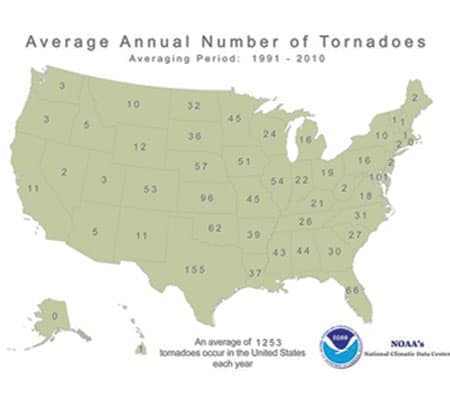
Here is important, potentially lifesaving information about tornados from Weather Underground:
- Develop an emergency plan for your family
- Know where safety shelters are located
- Monitor NOAA Weather Radio when severe weather is forecast
- Know the difference between a tornado watch and warning – a watch means conditions are right for tornado activity and people should be on alert, a warning means a tornado has been sighted and you should take shelter immediately
Here are tornado danger signs:
- Dark, greenish sky
- Large hail
- A large, dark, low-lying cloud that may be rotating
- A loud roar, often compared to a freight train
These are dos and don’ts from the American Red Cross if you are caught in a tornado:
- Do go immediately to an underground shelter, basement or safe room
- Do find a small windowless room in the interior of a home or hallway on the lowest level of a sturdy building
- Don’t stay in a mobile home unless absolutely necessary
- Do stay in your vehicle with the seat belt fastened and your head below the windows, covering your head with a blanket, coat or your hands
- Do go to a low lying area like a culvert or ditch if caught outdoors and cover your head with a coat or your hands
After a tornado:
- Continue listening to local news or a NOAA Weather Radio for updated information and instructions.
- If you are away from home, return only when authorities say it is safe to do so.
- Wear long pants, a long-sleeved shirt and sturdy shoes when examining your walls, doors, staircases and windows for damage.
- Watch out for fallen power lines or broken gas lines and report them to the utility company immediately.
- Stay out of damaged buildings.
- Use battery-powered flashlights when examining buildings – do NOT use candles.
- If you smell gas or hear a blowing or hissing noise, open a window and get everyone out of the building quickly and call the gas company or fire department.
- Take pictures of damage, both of the building and its contents, for insurance claims.
- Use the telephone only for emergency calls.
- Keep all of your animals under your direct control.
- Clean up spilled medications, bleaches, gasoline or other flammable liquids that could become a fire hazard.
- Check for injuries. If you are trained, provide first aid to persons in need until emergency responders arrive.
Some common myths associated with tornados are:
- Leave windows open to equalize pressure
- Tornados don’t hit large cities
- Tornados don’t occur in mountains
- Seeking shelter under an overpass is a safe
There is new information from recent storms that sturdy garage doors may be the best protector of a home. The study of tornado damage found wood frame homes with sturdy garage doors suffered less damage than homes with flimsy garage doors.
The research from the University of Alabama also concluded that tornado shelters – underground or above ground safe rooms – saved lives.
The researchers compared damage from major tornadoes that struck Moore, Oklahoma in 2013 to studies of similar storms that hit Tuscaloosa, Alabama and Joplin, Missouri in 2011.
Some of the conclusions:
- Flimsy garage doors proved to be a weak link, allowing pressurization that destroyed supporting walls and the roof when the garage was breached by devastating winds
- Storm shelters save lives even in the worst tornadoes
- In the areas damaged by lesser winds, the garage was often the root cause for failure of residential structures, allowing roofs and supporting walls to collapse
The study found that increased building safety standards and incorporation of more storm shelters are working to prevent some damage and save lives.
If your property suffers damage from a tornado:
- Secure the property from further damage or theft
- Contact your insurance company as soon as possible
- Inventory losses and take photos
- Save receipts of meals, purchases and hotels related to not being able to live in your home
- Be careful of unscrupulous contractors
This is also a reminder how important it is to take an inventory of your home and possessions before a disaster strikes.
Another way to protect your home is with an insurance policy review. Call a California Casualty advisor today, 1.800.800.9410 or visit www.calcas.com.
This article is furnished by California Casualty, providing auto and home insurance to educators, law enforcement officers, firefighters and nurses. Get a quote at 1.800.800.9410 or www.calcas.com.
Resources for this article:
https://www.nws.noaa.gov/om/severeweather/resources/ttl6-10.pdf
https://www.redcross.org/prepare/disaster/tornado
https://www.wunderground.com/resources/severe/tornado_safety.asp?MR=1
https://www.pciaa.net
https://esridev.caps.ua.edu/MooreTornado/Images/MooreTornadoFinalReport.pdf
by California Casualty | Homeowners Insurance Info |
California is parched, and bracing for another scary fire year. Once again, much needed rain and snow has eluded the state. The snow pack is a paltry six percent of normal and this January through March was the driest ever in recorded history. The U.S. Drought Monitor has much of the Golden State in extreme or exceptional drought.
In many areas the unprecedented drought has reduced the greenery to dried sticks and CAL FIRE is warning that moisture content in fuels like trees and grasses are at extremely low levels – leaving them tinder dry and susceptible to wildfire.
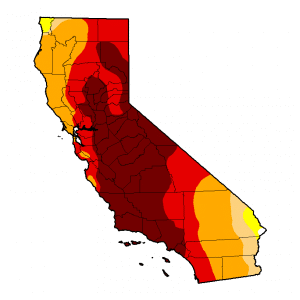
2015 Exceptional Drought-U.S. Drought Monitor
The National Interagency Fire Center is predicting above normal wildland fire potential for much of California, starting in May and June and continuing through fall.
It is imperative that you take steps NOW to protect your home and property.
That’s why California Casualty has prepared this important fire prevention information, because we have a stake in keeping you, your family and your most important asset as safe as possible.
Home Wildfire Prevention Tips:
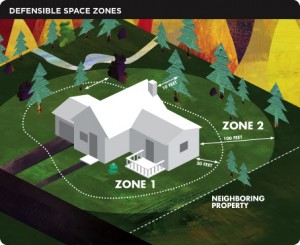
- Create a 30-foot defensible space around your home by removing as much flammable material as you can. Replace flammable vegetation with fire resistive plants.*
- Reduce the number of trees in heavily wooded areas by spacing native trees and shrubs at least 10 feet apart. On trees taller than 18 feet, prune lower branches six to ten feet off the ground.
- Remove branches overhanging the roof or coming within 10 feet of the chimney. Clean all dead leaves and needles from the roof, gutters, and yard.
- Install a roof that meets a fire classification of “Class B” or better. Cover the chimney outlet and stovepipe with nonflammable screening no larger than half-inch mesh.
- Install dual- or triple-paned windows, and limit the size and number of windows that face large areas of vegetation.
- Put woodpiles and liquid propane gas tanks at least 30 feet from all structures and clear away flammable vegetation within 10 feet of those woodpiles and propane tanks.
*California Casualty has a free “Reducing Wildfire Risk” pamphlet available here. You can also find additional helpful information linked from our home insurance page.
Help Firefighters Save Your Home!
- Make access easy. Roads need to be wide enough to accommodate fire trucks with room for them to turn around. Driveways and bridges must be strong enough to carry heavy emergency vehicles and equipment. Identify at least two ways to and from your house and make sure they are clearly marked. All access routes should be free of low hanging tree branches and cleared of flammable vegetation at least 10 feet from roads and five feet from driveways.
- Maintain an emergency water supply that meets fire department standards, such as a community water hydrant system, or a cooperative emergency storage tank with neighbors. If your water comes from a well, consider an emergency generator to operate the pump during a power failure. Clearly mark all water sources and create easy access to your closest emergency water source.
If You’re Forced to Evacuate:
- Know the best routes to safe areas and practice them with your family.
- Prepare an evacuation kit ahead of time.
- Know where and how you and your family will reconnect if you become separated.
In case of possible evacuation, your kit should contain the following items:
- Social Security cards
- Driver’s licenses
- Credit cards
- House deed
- Copies of vehicle titles
- Marriage license
- Birth certificates
- Copies of insurance policies
- Home inventory list / photos
- Health insurance cards
- Prescription medications
- Baby food or formula (if you have little ones)
- Important personal computer information downloaded to disk
- Valuable jewelry
- Photographs
- Home videos
- Items with sentimental value, such as wedding dress or baby keepsakes
- One week’s worth of clothing
- Pets with ID tags, carriers, and pet food
FEMA has more information about evacuation kit and plans at https://www.ready.gov/build-a-kit
Insurance Tips if You’re Impacted:
- Residents evacuated from their homes should contact their insurance agents or companies immediately and let them know where they can be reached. As adjusters are allowed into the burned-out areas they will want to go in with their policyholders to assess the damage. Many companies will set up 24-hour emergency hotlines.
- Keep receipts. Out of pocket expenses during a mandatory evacuation are reimbursable under most standard homeowner policies.
- Be prepared to give your agent or insurance representative a description of your damage.
- Take photos of the damaged areas. These will help with your claims process and will assist the adjuster in the investigation.
- Prepare a detailed inventory of all damaged or destroyed personal property. Be sure to make two copies-one for yourself and one for the adjuster. Your list should be as complete as possible, including a description of the items, dates of purchase or approximate age, cost at time of purchase and estimated replacement cost.
- Make whatever temporary repairs you can. Cover broken windows, damaged roofs and walls to prevent further destruction. Save receipts for supplies and materials you purchase. Your company will reimburse you for reasonable expenses in making temporary repairs.
- Secure a detailed estimate for permanent repairs to your home from a reliable contractor and give it to the adjuster. The estimate should contain the proposed repairs, repair costs and replacement prices.
- Serious losses will be given priority. If your home has been destroyed or seriously damaged, your agent will do everything possible to assure that you are given priority.
Don’t forget to make a complete inventory of all the items in your home before disaster strikes – doing so will help if you have to make a claim.
Here’s a List of Fire Prevention Resources:
www.calfire.ca.gov/fire-prevention
www.nfpa.org
www.disastersafety.org
https://www.redcross.org/images/MEDIA_CustomProductCatalog/m4340149_Wildfire.pdf
https://www.ready.gov/build-a-kit
https://www.knowyourstuff.org/iii/login.html
A defensible space pamphlet from California Casualty can be found on our resource page, www.calcas.com/resources.
by California Casualty | Educators |
Technology will always be a double-edged sword, regardless of what it does or where it’s used. This is perhaps no more evident than in the classroom.
While new technologies give students access to more information than any previous generation has ever had, the advance also entails negative effects. As a teacher, it’s important for you to understand the advantages and disadvantages of technology in the classroom and how to maximize the former while diminishing the latter.
Pros of Technology in the Classroom

The benefits of technology in the classroom are numerous. Take a look at some of the top advantages:
- Independent learning. According to Sam Eldakak, a researcher and author who has spent a great deal of time analyzing the issue of technology in the classroom, “Students who collect data from the Internet can be self-directed and independent.” In other words, the web gives students an opportunity to make discoveries and pursue learning in ways that were once impossible without the assistance of a librarian or informed professor.
- More engagement. The Internet provides students with engaging content that isn’t rivaled by boring textbooks. For example, a student who’s asked to write a research paper on Bengal tigers can watch a YouTube video of the animals in their natural habitat, listen to an interview with a zoologist, and pull up colorful infographics with compelling statistics …as opposed to reading a chapter in a book and relying on a couple of black and white images.
- Better teaching opportunities. For teachers, technology can greatly enhance the way you manage the classroom and present new material. You too have access to videos, online resources, and various new technologies. Using these to make lectures more interesting, you can actually do students a favor and encourage them to learn.
Drawbacks of technology in the classroom

Despite plenty of positives of technology in the classroom, there are also a handful of potential negatives. Here’s a look at a few of those:
- More distractions. According to Faria Sana, a McMaster University researcher, allowing tablets, laptops, and mobile devices in the classroom can be detrimental to learning. “It can change your grade from a B+ to a B-,” she explains. Her argument is that while technology enhances the potential for learning, it’s often used inappropriately in the hands of irresponsible students. As a result, it serves as a distracting force, rather than an empowering one.
- Encourages laziness. Some within the educational system believe technology has encouraged laziness in students by giving them everything they need at their fingertips. Instead of having to actually learn, students can grab the information they need and merely regurgitate it without being required to digest and shape it, let alone think for themselves.
- Makes cheating easier. Small devices can be hidden virtually anywhere and used to find answers to tests or homework questions. It’s also possible for students to take a picture of a test and send it to their friends. While dishonest students will probably always find a way to cheat, technology makes it so much easier, and therefore possibly more widespread.
How to handle technology in the classroom

As a teacher or school administrator, it’s up to you to determine how technology will be handled in the classroom. Although you can’t control everything, there are certain aspects you can influence to achieve a more positive and effective learning environment. By maximizing the advantages and limiting the disadvantages, you can ensure your students are better poised for success.
California Casualty: auto insurance for teachers
At California Casualty, we have a great deal of respect and appreciation for the teachers in our communities. We firmly believe in the power of education and admire the dedication and commitment our educators bequeath us on a daily basis.
In addition, we believe all teachers should have reliable, dependable, and fair auto insurance. That’s why we offer some of the best policies in the industry. For more information, please don’t hesitate to contact us today!
by California Casualty | Nominate a Hero |

Leslyn has been a nurse for 20 years and her close friends call her a healer. Whether it’s a person, or small animal, she stops to give the best care to each one with compassion and kindness. Leslyn works in the ICU unit in Arizona. There was a 2 year old that had been burned from pulling a hot pot off the stove. Although the 2 year old was not in her assigned shift, Leslyn heard him crying and went to care for him, rocking him to sleep.
Even outside the hospital, Leslyn cares for close ones around her. Every Wednesday Leslyn has an infamous potluck for friends and family. Leslyn also has a tradition of keeping track of everyone’s birthday. On their special day, they get three candles on the cake representing the past, present and future. In her free time Leslyn volunteers at the ARC as a yoga teacher for adults with Down Syndrome and Autism. She also volunteers as a camp nurse at Camp Courage, a camp for children who have survived burns where she also teaches yoga.
by California Casualty | Educators |
Classroom management is one of the central facets of teaching … and often the most difficult. This is especially true for high school teachers, because teenage students tend to be more rebellious and uncooperative.
By understanding the challenges you face and learning to strengthen your classroom management skills, you can promote a healthier learning environment that enables your students to thrive.
Understand your problem
Do you know what the issue is? Why does your classroom get out of hand, and is there something students are taking advantage of?
These are questions you have to ask at the outset. Before you can tackle classroom management, you must take a critical look at yourself and determine the root of the problem.
For example, some teachers struggle with insecurity and aren’t confident enough to command a classroom. This is a major issue and must be dealt with as soon as possible.
Other instructors are people pleasers who don’t ever wish to offend or upset their students. In still other cases, teachers are too confrontational for their own good.
It’s up to you to identify what the issue is. While your students may be part of the problem, it almost always comes back to you in some way or other. If youaddress your issues first, you’ll be readyto implement strategic initiatives to combat poor classroom behavior.
Tips for better classroom management
If you’ve come to terms with your strengths and weaknesses, you’re ready to home in on specific tips and techniques for offsetting challenges and using your assets to manage classroom behavior more effectively.
Here are a few to get you started:

- Take charge from day one. As every teacher knows, it’s much easier to start strict and potentially loosen your grip later than the other way around. At the beginning of each semester — and ideally every day — you should begin by taking charge of the classroom and commanding respect. You do this by drawing students in, curbing side conversations, and directing the focus toward the subject matter.

- Provide positive reinforcement. While an unruly classroom can strain your patience, it’s important to give credit where it is due. When a student does something well, provides a valuable insight, or follows the rules, praise him or her for cooperation. Students need to know that good behavior will be rewarded as much as bad behavior won’t be tolerated.

- Focus on engaging content. The truth is that most classroom behavior issues can be overcome by creating engaging content and hands-on lessons. Contrary to popular belief, most students are interested in learning; you simply need to draw them in with something that’s sufficiently exciting and intriguing. Break up lectures with visuals and challenges to keep the focus on the content.
- Humanize yourself. Have you ever thought that maybe your classroom is unruly and out of control because they don’t have any reason to respect you? This can be a sobering thought, but it can be true. Have you taken the time to let your students know who you really are, or are you just another fact machine at the front of the classroom? Identify yourself by telling students who you are, where you’re from, what your interests are, and why you enjoy teaching. Students are much more likely to respect someone they understand.
- Handle issues swiftly. When problems arise, it’s up to you to handle them swiftly and effectively. Don’t let behavior issues go on for too long, or bad feelings will develop between you and your students. Address problems and actively pursue resolutions in a timely manner.
California Casualty auto insurance for teachers
As an educator, you deserve the very best protection and peace of mind you can get. At California Casualty, we offer this in the form of reliable auto insurance. For additional information on how our policies can keep you confident and protected on the road, please contact us today!