by California Casualty | Safety |

By: Mark Goldberg
I couldn’t believe it (well, then again nothing is that surprising these days) – the guy in the car ahead of me was shaving. It was early morning as we drove on a narrow two-lane road. He swerved numerous times as he continued grooming behind the wheel. It could have ended badly since there were school buses and elementary school children on the side of the road; luckily nobody was hit or hurt. The sad part is that he was oblivious to how dangerous his antics were.
Then, on a recent trip to visit our daughter, my wife and I witnessed drivers passing on the far right on the interstate, wildly veering across three lanes and then back to the left lane. Others were tailgating at such a high speed that there was no way they would avoid slamming into the car ahead if traffic suddenly came to a stop.
We’ve all seen it; people with angry faces, often gesturing, as the careen through our thoroughfares as if they were the only one who mattered. As we encounter the growing number of distracted and aggressive drivers, it got me thinking about how we all need to be hyper-aware and drive with extra precaution.

So, what can you do?
- Stay out of the left lane unless you are passing
- Don’t challenge them by speeding up or trying to block them
- Follow the speed limit
- Avoid eye contact
- Report them to authorities providing vehicle description, license plate number, location and direction of travel
Gesturing back or making eye contact can often lead to road rage.
And here are some defensive driving tips that can help you avoid confrontations with aggressive drivers:
- Keep scanning the area ahead and behind you
- Drive with both hands on the wheel to better respond to dangers
- Wear your seatbelt
- Slow down in bad weather
- Have an escape plan
- Don’t follow too close
- Avoid driving when tired or drowsy
Experts recommend that you take a defensive driving course to learn these techniques; besides it can also qualify you for a discount on your auto insurance.
California Casualty is dedicated to preventing this type of driving behavior. That’s why we are proud to be a major sponsor of Impact Teen Drivers, a nonprofit formed with the law enforcement and education groups that uses peer-to-peer tactics to educate teen and young adults about the dangers of distracted and reckless driving. Learn more at https://www.calcas.com/web/ccmc/impact-teen-drivers.
Before you hit the road, make sure you have adequate protection in case you encounter a distracted or aggressive driver. Call a California Casualty advisor today for an auto policy review or comparison at 1.800.800.9410 or visit www.calcas.com.
Sources for this article:
https://www.nhtsa.gov/people/injury/aggressive/Aggressive%20Web/index.html
https://www.nhtsa.gov/people/injury/enforce/aggdrv.html
https://auto.howstuffworks.com/car-driving-safety/accidents-hazardous-conditions/10-safe-driving-tips.htm#page=9
https://www.distraction.gov/
https://roadragers.com/road-rage-advice.htm
by California Casualty | News |
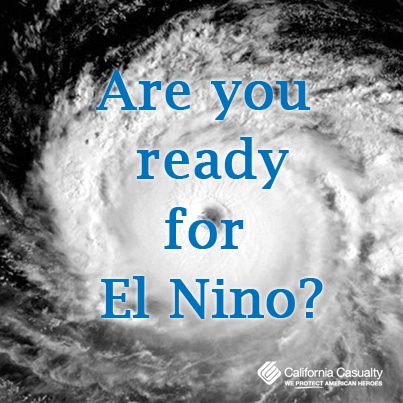
Get ready, El Niño is back. The National Oceanic Atmospheric Administration (NOAA) says continued heating in the Pacific Ocean means a strong event this fall and winter. Wind conditions and several tropical cyclones are indications of an intensifying effect which could lead to one of the strongest El Niño’s in a long time.
NOAA and other climate watchers say while every El Niño is different, these are some general things we can expect:
- Cooler, wetter weather in the southern U.S. with possible heavy storms and flooding
- Wetter weather for Southern and Central California with intense rain and possible flooding and mudslides
- Drier, warmer weather in the Pacific Northwest and Central U.S.
- Slightly warmer weather in the Rocky Mountain Region, but with strong snow storms and blizzards (some of the biggest blizzards have come during past El Niño years)
- Warmer and drier on the East Coast
- Less Atlantic hurricanes but more Pacific cyclones and hurricanes
Here are some tips before the wild weather blows in:
- Make sure your vehicles have comprehensive coverage for damage from weather, flooding, mudslides, falling objects (rocks and trees), etc.
- Check your auto’s tires to make sure they will provide traction in rainy, icy or snowy weather
- Inspect the roof of your home to make sure it’s ready for the onslaught of heavy rain, snow or ice
- Make sure your gutters and downspouts channel water away from your home
- Trim branches and trees that could blow onto your roof or home in a heavy storm
The Insurance Information Institute estimates that over the past five years, damage from wind and storms has been the number one cause of damage claims to homes, with the average payment just under $8,800. Before El Niño takes aim at your home, they recommend you:
- Review your insurance to make sure you are covered for storm loss
- Purchase flood insurance (which is not included with most homeowners insurance) if you live in a flood prone area
- Talk with your insurance company to make sure you have the adequate limits and deductibles
- Take an inventory of all the possessions you own
No matter the weather, California Casualty is ready to help with your storm insurance preparations. Contact an advisor today for a policy review or comparison at 1.800.800.9410 or visit www.calcas.com.
Sources for this article:
https://www.oc.nps.edu/webmodules/ENSO/NA_EN.html
https://www.cpc.ncep.noaa.gov/products/analysis_monitoring/enso_advisory/ensodisc.html
https://mashable.com/2015/07/09/strongest-el-nino-on-record/
https://www.iii.org/fact-statistic/homeowners-and-renters-insurance
https://www.pciaa.net/pciwebsite/cms/content/viewpage?sitePageId=42247
https://www.iii.org/fact-statistic/homeowners-and-renters-insurance
https://www.knowyourstuff.org/iii/login.html
by California Casualty | Educators |

The face of education is changing with the rapid acceleration of smartphones, learning pads and computers into schools. While new electronic learning options open exciting opportunities for engagement and creative possibilities, there is a raging debate about its effectiveness. Many are also warning about some negative implications.
Edutopia contributors have been writing about technology integration for years. Their website has a dedicated section about the adoption of technology in the classroom and how it is changing learning. But judging by the point and counterpoint, there’s much more still to be decided. Here are some of the pros and cons to merging electronics into the classroom.
Pros
Multiple studies show advanced learning systems can enhance student engagement and motivation. A Stanford Center for Opportunity Policy in Education study found when implemented properly, the use of tablets and computers has produced significant gains in student achievement while boosting engagement. One of the paper’s conclusions is that while all students benefit from technology, the greatest impact was on those most at-risk.
Using computers and tablets in class has shown to improve student cooperation and collaboration. It has also created a new approach to class time called, “blended learning” – combining digital content with face-to-face discussions and activities. An NEA Today article discussed the pros and cons of allowing bring your own device policies being introduced in many school districts to aid the “flipped” classroom strategy.
Other noted advantages of technology in the classroom are:
- Easier communication with parents and students
- Faster turn-around on papers and grading
- Quicker access to information
- Addition of learning games and other activities for students
- Introducing students to careers and technology based applications for the future
- Integrating the apps and devices children are already using into learning and research opportunities
Many experts say there is no going back on advancing technology, and many educators are convinced it has opened new doors for teaching and engagement.
Cons
The other side of the debate warns that unbridled use of technology in the classroom can dumb-down student learning, waste taxpayer dollars, and leave some teachers and students lost in a maze of technological difficulties leading to lack of adaptation.
First, there’s the expense. Many school districts have jumped headfirst in the technology pool without thinking about the effects. A classic example is Los Angeles Unified School District’s $100 million dollar iPad fiasco. The deal was scrapped after issues surfaced with late delivery, incomplete software and teacher complaints about inadequate time and support to integrate the systems. Some experts warn that many school districts and administrators are allocating money for technology because they believe they have to, not necessarily because they need it. Also, many districts don’t factor in the cost of updates and how quickly new technology becomes outdated.
Another problem was highlighted in an article by technology writer Benjamin Herold, which found students using digital readers retained less information. They were more likely to skim the texts and were more distracted by links and other digital extras than students who read from a book or magazine. Herold advises that there needs to be a better understanding of comprehension issues before e-readers are mainstreamed in the classroom.
Other authors have raised concerns about cyberbullying and students who may seem savvy, but are actually not as adept they appear to be in using their devices for deeper learning and research applications.
And in a recent study, educator Katie Davis and Harvard professor Howard Gardner found the reliance on apps by today’s youth may be harming creativity and could inhibit reflective thinking, which they say affects the ability to build empathy and understanding of others.
Other problems with technology:
- Wasted time with connectivity and downloading or buffering issues (insufficient band-width)
- Teachers and students frustrated by inadequate technology support
- Lack of training and understanding of how to integrate technology into lesson plans and learning
- Incompatibility with existing systems
- Not enough computers, laptops or tablets for all students
- Unreal expectations that technology will improve student performance
So, what is the solution? A recent summit of top educators (including 2014 National Teacher of the Year Sean McComb), ed-tech advocates and policy makers developed six key points to help make integration of technology in the classroom more successful:
- Allocate more time for professional development with technology
- Reimagine the ecosystem and the offerings for professional development
- Move from 20th– to 21st– century training
- Change the school culture to encourage trust and experimentation
- Redefine leadership, recognizing teachers and students may have more technological expertise
- Create meaningful mentorship opportunities
While it appears nobody can stop the advance of new learning systems, many are urging decision makers, administrators and teachers to take a long look at what e-readers, laptops and tablets can do and to understand the implications of improper implementation.
And whether it’s for tablets, electronic learning games, or new books and pencils, California Casualty is ready to help with the $2,500 Academic Award. The funds can be used for any classroom supplies and materials that will benefit students. The information and application can be found at www.calcasacademicaward.com.
https://www.scpr.org/news/2015/04/17/51093/schools-dealing-with-aftermath-of-lausd-s-ipad-fia/
https://712educators.about.com/od/technologyandeducation/tp/Issues-With-Integrating-Technology-In-The-Classroom.htm
https://neatoday.org/2012/07/19/should-schools-embrace-bring-your-own-device/
https://www.edutopia.org/technology-integration-guide-implementation
https://www.edutopia.org/technology-integration
https://www.changetheequation.org/press/new-report-change-equation-finds-american-millennials-lack-tech-savvy-stresses-value-k-12
https://thejournal.com/articles/2015/06/16/is-the-app-mentality-killing-students-creativity.aspx?=THEMOB
by California Casualty | Firefighters |

San Mateo, CA, October 8, 2015 – October is an important month for firefighters across the country. Not only is it Fire Prevention Month, but it’s also when they pause to remember fellow comrades at the National Fallen Firefighters Foundation Memorial in Maryland.
In 2014, 84 men and women in the United States lost their lives in the line of duty. Despite that, thousands of dedicated fire personnel continue to put on the uniform and charge into dangerous situations to help others.
Too often, their heroics and sacrifice go unnoticed. That’s why California Casualty created Nominate A Hero, a program to encourage others to highlight those who make our communities better. First responder Heroes of the Month include California fireman Joe Benton who suffered serious injuries fighting an outbreak of wildfires and is now a fire inspector, and firefighter/CPR instructor Robert Stevens who volunteers at the local school district and also helps aspiring firefighters apply and study for the firefighter exam. To honor a hero you know, go to www.nominatemyhero.com.
California Casualty is also encouraging the public to join them in donating to relief funds aimed at helping firefighters who lost homes while selflessly protecting their communities during the disastrous California fires. Information can be found here at CSFA website.
“We think it’s important to say thank you and support the courageous men and women who protect us,” said Mike McCormick, California Casualty Sr. Vice President.
Learn more about California Casualty and its 40 year partnership with firefighters at www.calcas.com/firefighters.
by California Casualty | Homeowners Insurance Info |

If you live in a flood prone area, you should have flood insurance. It seems like common sense but many of us still don’t get it. As rivers crested to new heights and raging waters destroyed homes in Central and Southern Texas this spring, the Insurance Council of Texas fears that less than half of those with damage purchased a flood policy. Many thousands affected by record flooding in South Carolina may also be without flood insurance; state insurance companies estimate that only 10% of residents purchased flood protection.
Here are some reasons why people don’t buy flood insurance:
- They think their homeowners or renters insurance covers flooding
- They think the government will help them
- They think it’s too expensive
- They didn’t know it was available
Floods are the number one disaster in the United States and the National Flood Insurance Program estimates that just three inches of water in a 2,000 square foot house will result in $23,000 in damage.
With that in mind, let’s soak up seven myths that might be floating around about flood insurance.
- Flooding is covered under most homeowners insurance.
It is not. Homeowners and renters need to purchase separate flood insurance protection. Umbrella insurance does not usually cover flooding.
- I don’t live in a flood prone area so I don’t need it.
Every state in the union has experienced flooding and it can happen anywhere. The National Flood Insurance Program estimates that 25 percent of flood claims come from areas outside of high-risk flood zones.
- The Federal Government will help pay for flood damage.
Federal disaster assistance is only available when the president formally declares a disaster. The aid comes as low interest loans, not compensation for your damage.
- Flood insurance is only for homeowners and businesses.
Flood insurance is available to renters. It is also available to condo owners and renters. It will cover damage to your possessions from a flood.
- Flood Insurance is expensive.
The average policy costs about $700 per year: the higher your risk, the higher your premium. Keep in mind the average residential flood claim amounted to more than $38,000.
- I can get flood insurance coverage immediately.
In most cases there is a 30 day waiting period from the date you purchase the insurance before it goes into effect.
- I can shop around for the best flood insurance deal.
While you can purchase flood insurance from numerous companies, the price is set by the federal government and doesn’t vary. Rates do vary depending on your flood risk and the year and type of construction.
If you have experienced flood damage, here are some things you should be doing:
- Make sure the building is safe to enter – mud and water may contain dangerous chemicals, bacteria or poisonous snakes and there could be a risk from electrocution
- Secure the property from further damage or theft with plywood, tarps or plastic
- Remove branches and other debris
- Before cleanup, take photos or videos of all the damage
- Throw out water damaged food including canned goods
- Keep receipts for any items you buy to make temporary repairs and for living expenses, they may be covered if your loss is insured or can be used for tax purposes if the loss is not covered
- Contact your insurance company – flooding and other water damage to your vehicle is covered if you have comprehensive auto insurance
For more information about what is and is not covered with flood insurance, visit https://www.floodsmart.gov/floodsmart/pages/residential_coverage/whats_covered.jsp.
California Casualty can help keep you above water with flood insurance. Find out more today at 877.652.2638 or visit www.calcas.com/flood-insurance. Make sure your property is fully protected from wind, fire, lightning, hail or falling trees with a policy review by calling an advisor today at 1.800.800.9410 or visiting www.calcas.com.
Resources for this article:
https://www.floodsmart.gov.
https://www.ready.gov/floods
https://www.thestate.com/news/local/article37740939.html