It’s August, which means it’s officially back to school season, and many teachers are working hard in their classroom to get it prepared for that first day!
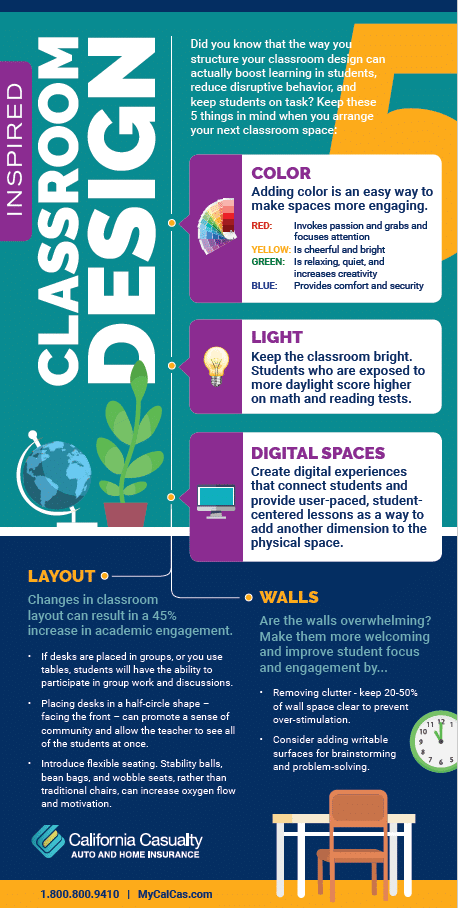
An organized classroom is an integral part of the learning process. Did you know that the way you structure you classroom design can actually boost learning in students, reduce disruptive behavior, and keep them on task? Behavioral problems in children have been linked back to poor color planning and lighting alone! So, keep these 5 classroom design tips in mind when you organize your space this year:
1. Color
White walls are under-stimulating, while too much color causes over-stimulation. The key to “coloring your classroom” is to find balance and make it comfortable. When using color you want something that is conductive to learning, while positively promoting mental and physical well-being.
For Young Children: Use brighter, warm, colors to draw in their focus on whats going on in the classroom instead of outside, like: yellow, red and orange.
For Older Children: Use calming colors that allow the teenagers to focus on their work, and not their surroundings, like: blue, purple, green, and gray.
If you are able to paint your classroom avoid picking colors that are too bright. Instead pick a more muted shade that will not be distracting. And when you have chosen a color palette do not paint the entire room, instead paint a wall or two and leave the rest neutral. If you’re school does not allow you to paint you could always follow the color scheme you like with your decor. Find posters and create bulletin boards around the color theme you like, and buy furniture for your classroom (like chairs, rugs, storage bins, shelves, etc.) that complement that theme.
2. Light
Harsh lighting can cause headaches and disruptive behavior in students, so it is important to find the proper lighting for your classroom. Research shows that with the right lighting student’s test scores even increase! The key is to use as much natural light as you can, or lights that imitate natural light (aka lights with blue undertones). When students are taking tests, the natural feel helps them relax and focus. If you don’t have enough natural light or you prefer to keep the lights off you can fill up your classroom with lamps, hanging lights, or Christmas lights. Just try and avoid yellow undertones because those tend to make students more fatigued.
3. Digital Spaces
Students today are not just learning in the classroom, they are learning in the digital dimension. It is important for teachers to create digital experiences that connect students and provide-user paced, student-centered lessons as a way to add another dimension to the physical space. Providing resources to students digitally helps teachers build relationships with them. So, to help students feel safe in this space teachers must introduce it, establish rules and norms, and visit it frequently.
STEPS:
Choose an online system that best suites you and your class
Create an account and add your students
Create activities and set aside a specific time for those activities
Never stop exploring what’s new
Whether you have one online activity, or many, that you do with your students, you should have a spot in your classroom where online activity is represented. Consider a discussion board, or a table that you gather around to view. OR set aside time in the day/week that you do activities on a SMART board or computer together and create in-person activities that go along with them!
4. Layout
Classroom layout can result in a 45% increase in academic engagement.Desk arrangement all comes down to how much space you have, what you think would work best for your class, and how they learn. You could set your students in a:
Standard spaced out arrangement
Angled rows
Modified U or Horseshoe
Groups
Combination
Or choose one layout and then mix it up every quarter!
Another option is flexible seating for students. Flexible seating is student-centered and ditches the idea of a regular desk. Instead it focuses on a variety of different seating options varying from stools, bean bags, rockers, stability balls, couches, padded storage bins, pillows, etc. Students love it because they are not just stuck in a regular desk. They will have more mobility and can be more comfortable. As long as your students are happy and it boosts learning, the possibilities are endless!
5. Walls
The walls in your classroom should be fun and conducive to learning! So when you are decorating them, ask yourself from the student’s perspective, “Is this overwhelming?” A great idea that you have in your head or saw on Pinterest may have too much print or be too harshly colored for your students depending on their age. You should keep at least 20-50% of your walls clear to prevention over stimulation. However that doesn’t mean you can’t have fun with it!
You can fill your walls with positive messages, student crafts, and learning materials, but it is also recommended to have at least one wall set aside for student engagement. Something the students can go to everyday and find resources, learn new words/facts, interact with each other, or turn in their work.
If you are having trouble finding ideas for your classroom walls we have created a list of Bulletin Board Ideas and more, click here.
So, what are waiting for?! Go get that organized classroom started! But first, be sure to download our 5 Classroom Design Tips below.
Our Education Blogger is a public school teacher with over a decade of experience. She’s an active NEA member and enjoys writing about her experiences in the classroom.
An organized classroom is an integral part of the learning process. Your classroom should be an environment where quality learning occurs. It should also be a safe, organized space that allows students to thrive socially, academically, behaviorally, and creatively.
How Does An Organized Classroom Benefit Students?
Your classroom organization reflects the structure and management of your classroom. The classroom is a constant reminder to students of classroom expectations and procedures: organized classroom = high teacher expectations. Students also thrive in a predictable environment where they feel safe.
“Everything Has a Home”
I once heard a colleague say: “Everything Has A Home.” I love this line (and I use it at home with my own children). All items, whether in the classroom or in your home, have a specific place where they belong. Having specific, labeled locations for supplies, materials, and books makes for swift access and less time wasted.
Classroom Materials and Supplies
Materials and supplies that are used frequently should be easy to access for the teacher and students. Use baskets, storage bins, milk crates, and plastic drawers to help organize supplies. Labels are a big help, too.
Desk Arrangement
Preferences for how to arrange student desks varies greatly from teacher to teacher. One thing to think about is how you instruct or how you want students to learn. If you like students to work in groups, set up tables or clusters of desks. If you prefer whole group discussion, a U-shape or circle works well. Students working on self-paced learning may need learning stations. Many teachers also arrange student desks so they can make eye contact with as many students as possible. Students should also be able to see the instructor and the white board/projector. Whatever your preference, make sure you can move easily throughout the classroom.
Student Materials and Supplies
“Train” your students to be organized. Ask students to have a folder or binder for your class. If you require students to keep handouts, syllabi, and other paper materials with them, ask them to label a folder in which to keep said items. In my elementary classroom, we have a folder for each subject, a homework folder, and a Friday folder.
Why Should I Organize My Own Classroom?
In addition to benefiting students, classroom organization is also helpful to the teacher. Having an organized classroom allows teachers to spend more time on the more “important” stuff, like planning meaningful lessons and building student relationships. Creating and maintaining an organized classroom also causes less teacher stress, frustration, and fatigue. It sounds cheesy, but having a tidy classroom makes you look good to administrators and parents; you look like you’ve “got it together.” A neat and orderly classroom shows that you care about your students and your profession.
This article is furnished by California Casualty, providing auto and home insurance to educators, law enforcement officers, firefighters and nurses. Get a quote at 1.800.800.9410 or www.calcas.com.
Summer break is winding down. Your mind is becoming consumed with thoughts about heading back to school. For some, it’s an easy transition, but for others, it’s a shock to the system. As the calendar flips to August, get yourself refocused on lesson plans, gathering materials, and preparing for your first days back to school. These ideas are meant to help make your job a little less stressful.
Take little steps. Don’t try and do everything at once. Create a timeline of things you need to do before school begins and list the things you want or need. Plotting them on the timeline will help alleviate the feeling many get of being overwhelmed.
Make the first steps fun. Whatever you choose to do first, make it as fun as possible. Doing the easier things first, like creating classroom decorations and posters will remind you how much you love teaching and make the tougher items easier. Do more mundane things like unit planning or curriculum development at a café, park, or any place that offers distractions with good food and coffee.
Find a friend. Working with a colleague can make the tasks more enjoyable while cutting the work time in half.
Connect with kids. Interact with past or present students. Send out emails to new students welcoming them, and see if any previous students would like to help you get your classroom together. Seeing students will bring you joy and remind you why you went into teaching.
Organize your mind. The attitude brought into the new school year can often dictate how that year will go. Educators need to find thoughts that energize, empower and affirm all the good things that lie ahead.
Be rested, relaxed and ready – it will help the kids stay calm and focused.
Be organized and tidy – students will be impressed.
Have too much and too many of everything – there is nothing worse than being short on name tags or pens and pencils.
Over plan the lesson – make sure the lessons fill the time and don’t leave you scrambling to fill before lunch or recess.
Rehearse – practice your welcome back speech, check the pacing and if you are using technology arrive early to make sure it is in place and working.
Be ready for anything and everything – make sure a first aid kit ready, have the dean or assistant principal’s phone extension and have rules in place to handle any unexpected situations.
Start learning names immediately – this helps you connect to students quicker and shows them you are interested and care.
Back-to-school is right around the corner, and if you have been spending your summer catching up on all of the things you put off last school year, it’s time for a break. Finish up what is necessary, and enjoy these last weeks of summer before school stars up again!
Here are some ways to maximize the rest of your summer break to help you return rested. Plus, some tips to get your mind rejuvenated going into those first few weeks of school:
1. These last weeks of summer:Relax…..or Play
Book a last minute trip somewhere. Enjoy a weekend getaway to a city you’ve never been to, take road trip, or plan a stay-cation to explore your city
Treat yourself to a great meal, enjoy a day at the spa, or try a new yoga class
Spend a day poolside with friends or by yourself
Visit your favorite museum
Take your kids to an amusement park, go camping or bike riding
Go shopping for just what makes you happy
Volunteer for a cause that makes you feel good
Spend a day binge watching movies
Explore free concerts and festivals in your area
Stay up late and sleep in
2. Right Before School Starts: Reflect and Evaluate
During the last weeks of summer it is important to get your mind ready to go back-to-school. However, you don’t have to stress about getting prepared. Take it day-by-day and follow these tips by Special Education Coach Elizabeth Stein from her article Three Things You Can Do This Summer to Be a Better Teacher in the Fall:
Practice Mindfulness Everyday. Be more aware and accepting of circumstances and surroundings happening around you in every day life to better deal with stress and control your emotions in the classroom.
Read, Reflect and Plan. Find a book that you actually enjoy, that can double for pleasure and professional reading purposes. Reflect on it’s content and try to create a list of ideas that can elevate your instruction plans for the year.
Connect, Collaborate, Listen and Share. Spend a few days researching new technology-based tools and then link up with other instructors over lunch before the new school year. Share ideas and techniques with them and discover what they have learned, instead of doing it all on your own.
3. Those First Few Weeks: Don’t Burn Yourself Out
And finally, when the school year begins it is important to keep yourself in a positive head-space. Spend equal time doing things for school and things that make you happy to prevent getting burnt out. Wendi Pillars has written a piece for Edweek.org titled, Six Signs of – and Solutions for – Teacher Burnout. Burnout signs include:
Exhaustion
Anxiety
Feeling overwhelmed
Isolation
Wendi says when you are feeling any of these symptoms, it is important to practice these lessons:
Let go
Find balance
Be selfish sometimes
Embrace gratitude
Accept healing
Allow yourself to become stronger, more determined and focused by practicing Wendi’s steps to prevent burn out, in life and in the classroom. Remember, these lessons in those first few weeks of school when it seems like you are constantly on the go and don’t have time for yourself anymore. Even though you are so used to doing things for others, it is okay to take time for yourself and do the things you love, as well as teaching.
This article is furnished by California Casualty, providing auto and home insurance to educators, law enforcement officers, firefighters and nurses. Get a quote at 1.800.800.9410 or www.calcas.com.
Teachers play one of the most important roles in our lives growing up. They are our role models, our best friends, our confidants, our parents away from home, and so much more. Teachers are continually molding the minds of children and young adults all over the world to prepare them to be the next citizens and leaders in our society. Without exaggeration, they are changing lives every single day. discounts for teachers
With all that teachers give to us, it is important that we give back to them. So, just in time for back-to-school, we have rounded up a list of companies that offer discounts for teachers as a, “thank you” for what they do.
Each store is linked for you convenience, just click on the stores name, and it will direct you to their discount page!
Supplies
Target: July 13-20 get a 15% off discount on back to school essentials and supplies in store and online
Michaels:15% discounts for teachers year-round and special sales for educators throughout the year
Staples: 5/1-9/15 The Classroom Rewards Program lets 5% of each purchase by parents go back to the teacher of their choice as long as they are signed up for Staples Rewards
Office Depot and OfficeMax: 7/14–9/28 Teachers can get 20% back in rewards on qualifying in-store purchased as long as they are signed up for Office Depot OfficeMax Rewards
JOANN: 15% off discounts for teachers on every purchase daily
The Container Store:year-round discounts for teachers exclusively through email when you sign up for their free Organized Teacher Discount Program
Meijer: 7/7-9/28 use their 15% off with coupon for select school and office supplies; teachers can get a new coupon every time they shop in-store at the service desk
Lakeshore Learning Store: 15% off in-store qualifying items when you join their Teachers Club Members
Also be sure to check out Discount School Supply and Dollar Tree in-store and online, for amazing prices year round on all back-to-school essentials.
Books
Books-A-Million: 20% off discount on all items purchased in-store and free online shipping year-round with a free Books-A-Million Educator’s Discount Program Card
Barnes and Noble: 20% off publisher’s list price all purchases for the classroom
Book Warehouse: 15% off in-store purchases when you sign up for their free Educators Book Club
Thriftbooks: offers 15% off all used class sets when you have 20 or more used books in your cart and you use code “APPLE” at check out
Another resource to find cheap books is First Book Marketplace, where all books are 50-90% off and they have free resources. They also have discounted supplies and basic needs for children including snacks, personal hygiene items, and clothing.
Free Resources
PBS: PBS Learning Media offers free standard-aligned videos, interactive, lesson plans, and more
National Geographic: offers free activities, lesson plans, videos, infographics, photos, and more for Pre-K- Higher Ed
BLICK: offers free lesson plans and educational videos for visual arts education, and will also offer your school a discount if you purchase art supplies in large quantities
redwritethink: offers free lesson plans, student interactivities, calendar activities, and print outs in reading, writing, grammar, critical thinking and more for grades K-12
COMMONLIT: offers a free digital library of fiction and nonfiction for 3rd-12th grade classrooms
NASA for Educators: offers hundreds of resources for free that support the STEM curriculum
sharemylesson: offers thousands of free lesson plans that you can manually align to your standards of teaching, they even have lesson plans to focus on gifted students and students with disabilities
Scholastic: offers free lesson plans, classroom printables, posters, calendars, apps, and other resources as well as discounted books
Clothing
Madewell: 15% off your entire in-store purchase when you show your Teacher ID
LOFT:15% off your entire purchase when you show your Teacher ID
Banana Republic:15% off your entire full-priced, in-store purchase when you show your teacher ID
J. CREW:15% off your purchase with your Teacher ID
New York and Co.: 15% off your entire in-store purchase when you show your Teacher ID
Talbots: 15% off a full-priced purchase when you show your Teacher ID
Be sure toenter the $2,500 Academic Award Giveawayfrom California Casualty for your chance to win $2,500 to purchase supplies for your students and your classroom!
Happy back-to-school preparation! 🙂
This article is furnished by California Casualty, providing auto and home insurance to educators, law enforcement officers, firefighters and nurses. Get a free quote by calling 1.866.704.8614, or visit www.calcas.com.
Summertime for teachers doesn’t necessarily mean “vacation”. There are, lesson plans to develop, hours of PD sessions, and classrooms to prepare. Many teachers have summer jobs or teach summer school, so accomplishing goals and tasks that get put off during the school year is easier said than done.
We’ve put together a game plan to help you accomplish the top five realistic goals that teachers tend put on the back-burner during the school year. Even if what you want or need to do varies from the list below, writing down your goals is a solid first step to achieving them – especially if you are a teacher who is short on time. So open up your planner, grab your Flair pens and get ready to amaze yourself.
Goal #1: De-clutter
Less clutter = less stress = happiness 🙂
How to Accomplish: It’s time to channel your inner Marie Kondo. Getting rid of all of the clutter you’ve put aside planning to get to later needs to be the first thing you do this summer. The first thing?! We know. Bear with us. The sooner you put away all the stuff you carted home from your classroom, address the mountain of laundry in the corner, and tackle the layers of memories of years past- barely hanging on- beneath the magnets covering the fridge; the quicker you can start enjoying your summer. Clutter causes stress. To avoid stress, we avoid cluttered areas or try to pretend it isn’t there. Identify the area or room that gives you the most anxiety and start there. The quicker the clutter is gone, the quicker you can focus on more important things-like a cold drink by the pool.
Goal #2: Sleep
This one is pretty self-explanatory…
How to Accomplish: Draw the blinds and turn off all of your alarms. zzZZZZzzzzZZZzzzZZZzzz
Goal #3: Exercise
It’s beneficial for your physical AND mental well-being.
How to Accomplish: You don’t have to go crazy, buy a gym membership or start training 24/7…unless you want to. Exercise can range from number of different activities like: taking a walk, swimming, riding your bike to the playground with your children, or an intense game of water balloons. Set aside 30 minutes, 3 or 4 times a week to move your muscles and de-stress. Start looking at exercise as positive, like playing with your kids, and you will be more likely to do it instead of sitting on the couch dreading getting on the treadmill.
Goal #4: Work On Yourself
Take some time for “me-time”.
How to Accomplish: Whether you want to get started on your MBA or have a Harry Potter marathon in your PJ’s; write down a few things down you want to do this summer, solely for YOU and YOUR happiness, and make sure to follow through. Here are a few examples that we have rounded up & linked to sources for you, just click on each word!
Create & Read a Summer book list (for fun, not work)
You give so much of yourself during the school year. Be sure to take a little time during the summer for yourself to do and discover things that YOU love.
Goal #5: Spend Time with Friends & Family
They miss you during the school year.
How to Accomplish: Make a point to do things together as a family, like eating meals at the table, taking a road trip, or having a picnic in the park. Soak up all of the family time you can. During the summer is also a great time to talk to the family that doesn’t get to see you every day, like your parents or grandparents. Schedule time to visit or talk to them on the phone. And don’t forget about friends! Friends play a key role in our happiness and mental health so, set aside some time to get together for a night out, a backyard BBQ, or your other favorite activities.
The key to accomplishing summer goals is to keep them realistic. So set aside some time, choose what goals would make you the most happy, and go get your highlighters because this summer you are going to accomplish ALL of your summer goals. One color-coded tab at a time.
This article is furnished by California Casualty, providing auto and home insurance to educators, law enforcement officers, firefighters and nurses. Get a quote at 1.800.800.9410 or www.calcas.com.