by California Casualty | News |

By Mark Goldberg, California Casualty
I have a terrible admission to make: my daughter was bullied and I failed to recognize it. She is now a freshman in college and has used her experience to write her college admissions essay. While she is succeeding at school and in life, the scars of the insults, name calling and ostracizing still occasionally eat at her confidence and sense of self-worth.
She told me kids had been picking on her back in elementary school. The verbal, occasional physical assaults (pushing, hair pulling, etc.) and false rumors apparently increased in middle school and freshman and sophomore years in high school. I was fairly oblivious because she seemed well adjusted, getting good grades and active in school activities. She has since told me that she felt alone and that my advice that, “these things will pass” and “toughen up” made her feel even more isolated.
If it can happen to us, it can happen to any family. That’s why it is so important that parents, educators and others are aware of National Bullying Month.
October is National Bullying Month. The campaign began with a one week observation and informational campaign in 2006 by the nonprofit PACER Resource Center, created by parents of children and youth with disabilities, to help other parents and families facing similar challenges. Their statistics show more than 13 million American Children are bullied each year – one out of every three students – and bullying significantly impacts the emotional and physical well-being of those involved.
With the explosion of social media, cell phones and portable computers, bullying has been elevated to new levels through “cyber-bullying.”
PACER is encouraging individuals, schools, businesses and organizations around the country to show their support for National Bullying Prevention Month this year, by raising awareness and offering bullying prevention resources.
A highlight every year is Unity Day, where participants are urged to wear orange. The first Unity Day in 2011 was promoted by Ellen DeGeneres, and the day has gone viral via Facebook.
The National Education Association (NEA) is also a major proponent of ending bullying. They cite a report by Joel Haber, Ph.D., and author of Bullyproof Your Child for Life: Protect Your Child from Teasing, Taunting and Bullying for Good, that nearly one out of four children report experiences with bullying and 80 percent of high school students say they witness bullying at least once a week. Eliminating bullying takes the efforts of everybody and as the NEA aptly put it, “Students cannot learn if they are living in fear.”
For more information and resources on National Bullying Prevention Month, visit PACER at https://www.pacer.org/bullying/nbpm/, or learn more about the NEA’s myriad anti-bullying resources at https://www.nea.org/home/42485.htm.
There are also a number of valuable resources including the government’s national bullying prevention website and the Stomp Out Bullying webpage.
Sources for this article:
https://www.pacer.org/bullying/nbpm/
https://www.nea.org/home/42485.htm
https://www.stopbullying.gov/
https://www.stompoutbullying.org/index.php/campaigns/national-bullying-prevention-awareness-month/
by California Casualty | Nominate a Hero |

Lillian Maldonado French, as an educator and superintendent of Mountain View School District, has worked hard to make sure each student is making academic progress. She has integrated ways to provide resources for students, families, and staff in order for students to have what it takes to obtain academic goals.
While the school is in a low economic area, with help from Lillian, students are now getting many opportunities that higher economic area students are exposed to in other cities. Lillian is helping students find connections to systems for success through gateways to culture, academic exposure, university connections, funding for post-secondary education, rigorous academics and appropriate interventions to avoid gaps in learning achievement.
She believes in strong expectations when it comes to education to make the best positive learning environment for everyone. Lillian has helped increase parent involvement in the decision-making process of the schools. She listens to students, parents, and staff’s needs and concerns. Colleagues say Lillian has a true commitment to excellence for all students through not only her talk, but her walk by being involved in the community and focused on her students.
by California Casualty | Educators |
$2,500 can go a long way, especially for educators. It’s no secret that teachers spend out-of-pocket money for their students; what might surprise many is how much. A recent study from the National School Supply and Equipment Association found 99 percent of instructors used an average of $500 of their own money to equip their classrooms. However, many educators report putting out much more than that for school necessities, with the amounts closer to $1,000 to $2,000 each year.
There are many great resources to help classroom instructors stretch their budget for classroom supplies. Edutopia compiled grassroots tips and links from educators around the nation on getting free supplies and organizations that help teachers get the goods they need. They include:
Another is the California Casualty $2,500 Academic Award.
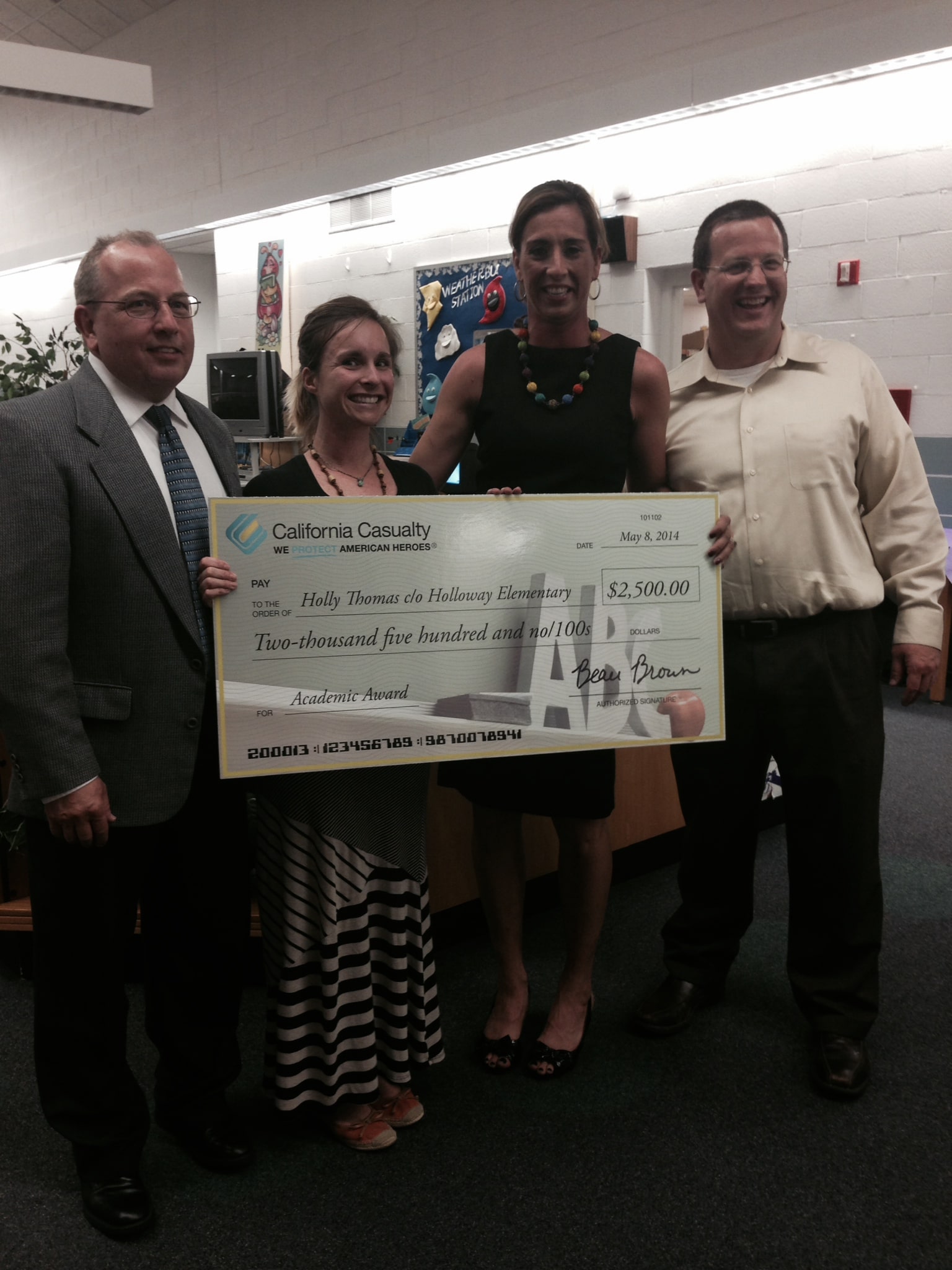
Ohio kindergarten teacher Holly Thomas is the most recent recipient. Holly says she routinely spends between $1,000 and $1,500 per year on her classroom and students. The grant has enabled her to buy bins and containers for the 500 children’s books and other materials she has accumulated in her 6 years as a teacher. She is also using her California Casualty Academic Award to augment the science center she has created in her classroom and will use some of the funds to build six garden boxes for her students to plant and enjoy. Holly is teaming up with the nonprofit ToledoGrows for the project.
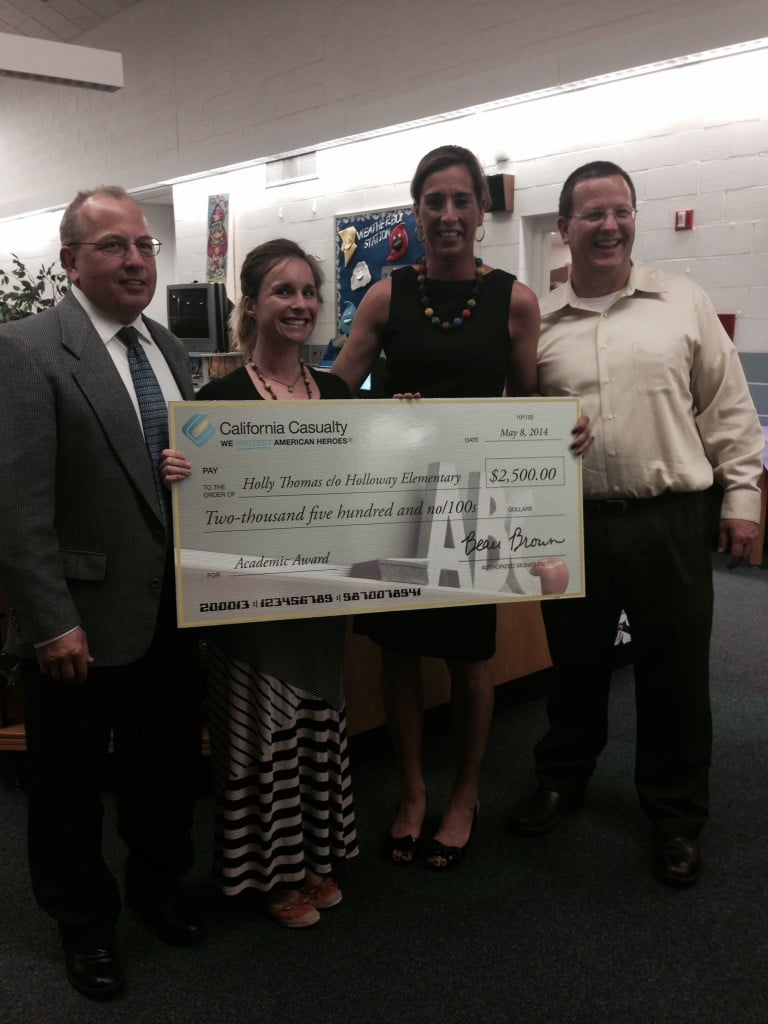
Holly, who is paying off student loans and covering tuition for her Master’s degree in Instruction and Curriculum, says having extra resources to purchase classroom needs as they arise has taken a lot of pressure off her finances and added to her well-being.
“We are repeatedly told we have to do more with less. With what we are expected to accomplish, with the resources available and the demands being put on us; my job is becoming more and more stressful. I try very hard to remind myself daily that I am molding the lives of five and six year olds”
Holly, urges instructors to take advantage of grant programs like the California Casualty Academic Award. She can now fund new ideas to help inspire her students. “It feels good to be supported by such amazing organizations as the NEA and California Casualty,” she said.

Elaine Tam was the recipient of the California Casualty Academic Award in August 2013. Elaine is a California high school teacher who applied the grant towards a trip to the Monterey Bay Aquarium. Forty eight students were able to tour the aquarium and enjoy the beautiful coastline in the area; many of them had never been to the ocean before. Elaine said, “As always, recognizing educators isn’t done nearly enough in society so this award is undoubtedly welcome.” She too urges educators to take a moment and apply.
Whether your need is for new technology, electronic tablets or traditional supplies of books, snacks, pencils and paper, do what Elaine and Holly did and let California Casualty pick up the tab with the $2,500 Academic Award. There are restrictions and official rules and the application can be found at www.calcasacademicaward.com.
Resources for this article:
https://blogs.edweek.org/
https://teacherscount.org/teacher/grants.shtml
https://www.edutopia.org/free-school-supplies-fundraising-donation
https://www.k12grants4teachers.com/
by California Casualty | Educators |

We understand that the day-to-day life of a teacher can be more difficult than many imagine. Hopefully, this humorous take on health and fitness for teachers will brighten your day!
It’s not easy to be a dedicated teacher and keep off those unwanted pounds. Here are 5 (satirical) tips on health and fitness for the busy educator!
1. Consume fewer calories than you burn:
Skip breakfast – this one should be pretty easy right? You have to get up at 5 a.m. and out the door at 5:30, so breakfast is usually just a longing glance at the fridge as you rush out. You can’t be late for the student’s arrival – plus, there are still papers to grade because you didn’t have them all finished at 11pm last night!
Since you have anywhere from 2-5 minutes for a leisurely lunch, you should try to stick with things that don’t need refrigeration and can be consumed through a straw.
Increased student/teacher ratios have undiscovered calorie-burning benefits! As you walk around to 30 or 40 desks to check progress and answer questions, think of the extra mileage you’re putting in!
2. Incorporate resistance training:
Resistance is part of the job! You regularly push back against those who aren’t focused on your students’ learning. You butt heads and lift up your students. You pretty much have resistance training down. Amplify the effect by trying to flex your abs during parent teacher conferences.
3. Try high intensity cardio:
You’re 50 yards from a bathroom, and you have 45 seconds before class starts. The full out sprint there and back should get your heart rate into the fat-burning zone! Try to repeat more than once a day.
4. Cut the carbs:
Refined carbohydrates and sugar cause your blood sugar to spike, leaving you groggy, unfocused, and grumpy. Why should you get to act like your students!?!? Instead, eat lots of veggies and be the only person in the room who isn’t napping.
5. Get plenty of rest.
Sleeping in isn’t an option, so the best you can do is get to bed early. As early as you can after staying late at school, caring for your family, grading papers, and fielding “emergency” parent emails……you know what? Forget it – just book a hotel room for the two weeks out of the summer you’re not working and try to sleep that entire time. Many hotel chains offer teacher discounts, and don’t forget to hang out the do-not-disturb sign!
**Bonus Tip!
Hydration is important. You get extra credit for this, as it really ramps up your high intensity sprints to the bathroom!
We hope these tips made you chuckle. At California Casualty, we appreciate how difficult it can be for teachers, which is why we created our Academic Award. You can win $2,500 for your classroom, just click here to enter.
by California Casualty | Safety |
Today is America’s PrepareAthon, the culmination of FEMA’s National Preparedness Month. The idea is for individuals, communities and organizations to be prepared for six specific hazards:
The message is that families, businesses and neighborhoods should know their risks, have a plan of action and prepare survival kits.
It got us thinking; “How prepared is California Casualty?”
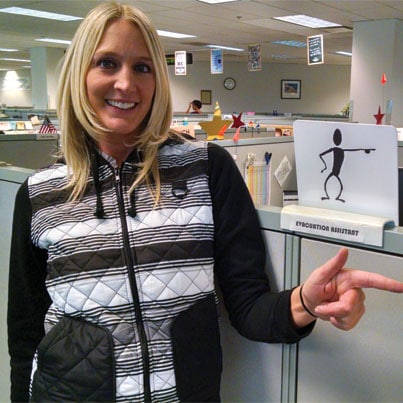
First, client and employee safety is paramount at California Casualty. Security systems are in place at all our service centers. The company conducts drills for fires and other possible occurrences – complete with trained safety personnel who help with evacuations and account for employees when safety zones are reached. These evacuation assistants are trained in first aid, CPR and the use of automatic electronic defibrillators (AED).
California Casualty has implemented a business continuity and recovery plan should an earthquake, flood, fire, tornado, power outage or winter storm adversely affect operations at one or more of our service centers. Managers carry contact information for every employee so they can be reached in an emergency. Systems are in place so that key personnel can operate remotely and phone and data systems can be shifted to service centers that have not been impacted. This minimizes inconvenience and potential disruption to policy holders.
Yearly table-top disaster scenarios are run to make sure managers know the procedures and backup systems they can utilize. In worse case scenarios, staff can be temporarily relocated to other services centers to maintain the continuity of service to clients. With service centers in Kansas, Colorado, Arizona and California, California Casualty has the redundancies and virtual call routing to maintain operations even if a service center is completely down.
California Casualty also has an emergency outreach plan for clients who may be affected by a disaster. Calls are made to areas that have been hit by flood, fire, tornado, hurricane or flood to make sure our insureds are okay and to expedite help with claims. Our Field Managers and Claims personnel respond to disaster areas to make contact with those insured with California Casualty and aid in their safety, relocation and recovery.
California Casualty works very hard to keep client information and data protected with numerous advanced data security protocols and monitoring. As an added layer of safety, every auto and home insurance policy includes free 911 ID Theft Protection.
Preventing tragedies is also a main concern. California Casualty strives to help our policy holders prepare for various disaster scenarios with many links and preparedness tips at our website’s Resources page.
Are you prepared? Today is the day to make sure with America’s PrepareAthon.