by California Casualty | Safety |
It’s officially September!
Goodbye Summer sunshine, hello Fall foliage!

Aside from being the season of cider and sweaters, Fall is also…
National Preparedness Month.
Here at CalCas, we will be celebrating by posting weekly Preparedness content right here on our Blog 🙂
First on deck: A Preparedness App!
As a recent iPhone converter, I am all aboard the App train. I’m always on the lookout for exciting new stuff and this new app from the Insurance Information Institute is one such find!
It’s called the “Know Your Plan” App and it’s all about streamlining your Disaster Prep Plans.
What you should know about this App:
What it provides:
- A library of preloaded preparedness checklists for disasters including:
- Hurricanes
- Floods
- Earthquakes
- Tornadoes
- Severe Cold
- Wildfires
- Evacuation
- Tips for preparing an emergency kit
- Important property protection information
- Step-by-step preparedness tips
- Custom lists for your personalized preparedness plan
- Targeted task completion dates
- Tools to chart your progress (including a countdown feature!)
- Checklists share options for family and friends
- Evacuation resources (even one for pets!)
- Geotargeted emergency alert feeds for up-to-the minute information about local evacuation routes and other disaster information
- User-customizable notes
As Fall and September swing into full gear, make sure you are ahead of the curve when it comes to Disaster Preparedness.
After all, you never know when you may need it.
By compiling disaster preparedness information and plans all in one place–on your phone–you are putting life-saving plans in place.
Stay tuned for more great Preparedness content throughout the month!
by California Casualty | Firefighters, Safety |
Do you have (or are you yourself) a student going away to school this fall?

(awww…)
The lists of things to remember to do before leaving home is immense: dorm necessities, vaccinations, class registrations… the list goes on and on.
In all the chaos and excitement, it’s hard to remember everything.
But the Los Angeles Fire Department came out with an important reminder this month: Prepare for the possibility of a fire in university housing.
Just like you have fire plans at home, at school, and at work, you also need one for Campus Housing.
Think it will never happen at your school?
155 people have died in campus-related fires since January 2000.
The National Fire Protection Association says fire departments responded to an average of 3,840 structure fires in dorms, fraternities, sororities and barracks between 2005-2009. Every year (on average), fires caused:
- 3 civilian deaths
- 28 civilian fire injuries
- $20.9 million in direct property damage
So what can YOU do to keep yourself or your child safe while they’re away?
1. Identify fire risks. 81% of reported fires involved cooking equipment
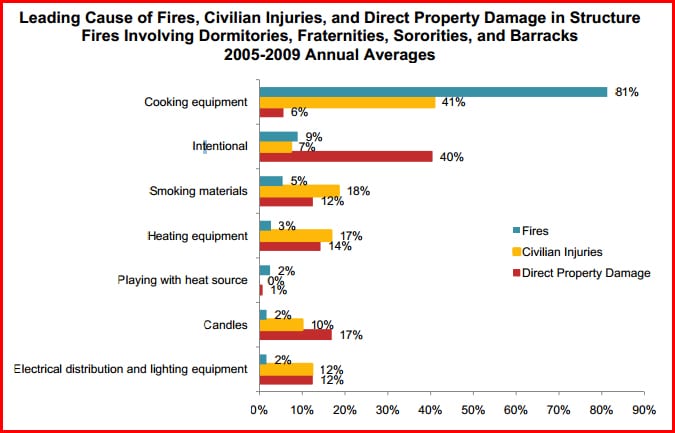
2. Know the Common Factors in Housing Fires: (source)
- Fires in campus housing are most common between the hours of 5 and 11 p.m.
- Lack of automatic fire sprinklers
- Missing or disabled smoke alarms
- Careless disposal of smoke materials
- Impaired judgment
- Fires originating on upholstered furniture on decks or porches
3. Follow these Tips: (source)
- Look for fully sprinklered housing
- Make sure your housing unit has smoke alarms inside each bedroom, outside every sleeping area and on each level
- Confirm that smoke alarms are tested at least monthly
- Never remove batteries or disable alarms
- Learn building evacuation plans and have a copy on hand BY the door. No organized plan? Make sure YOU have a fire escape plan with two ways out of every room
- Cook only where permitted
- Cook only when alert and not sleepy or drowsy
- Different states have different restrictions for use of BBQ grills, fire pits and chimeneas. Check with your local fire department before using these items- especially if you moved from out-of-state!
- Check with school rules on electrical appliances in your room
- Use the right surge protectors for your computers or electronics and make sure the protector is plugged directly into an outlet
4. Ask these Questions when you arrive at school or drop your student off there
We know this is a busy time for everyone. There’s a lot of excitement and preparation that goes into starting a new semester at school. But please be sure to take FIRE SAFETY into account. It’s a real risk that is too often forgotten, which can lead to deadly consequences.
Additional resources:
by California Casualty | Educators, Firefighters |
Here at California Casualty, we care about
the fun stuff.
We know auto and home insurance isn’t anybody’s absolute favorite thing to talk about. But that doesn’t mean we don’t have some fun around here. For me, the most entertaining part of my job is…
announcing the winners of our giveaways!
No matter what we are giving away, no matter who wins, no matter where they live… it’s always a blast.
They’re also excited.
They’re always surprised.
And they’re always so grateful.
(Which is slightly ironic, considering our giveaways reward people who truly deserve it and are our way of saying thanks to them.)
We’ve recently announced the winners of TWO giveaways: Our “Work Hard, Play Hard” Polaris ATV and Our School Lounge Makeover.
The winner of our Polaris ATV is a very deserving volunteer paramedic and EMS instructor named Ellie Piatt of Huber Heights, Ohio.
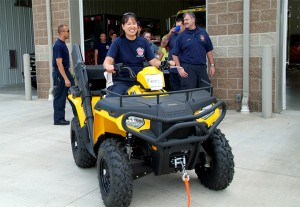
Congratulations, Ellie!
When we headed to Ohio to surprise Ellie at a department meeting, we learned she’d never even so much as sat on an ATV before! But that didn’t seem to curb her excitement. Ellie says she plans to use the $10,000 ATV to help her Bethel Township Fire Department better help the community.
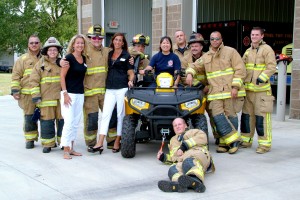 Ellie, The Bethel Township Fire Department, and member of the California Casualty team all posing with the Polaris ATV
An extremely selfless volunteer paramedic!? I guess we shouldn’t have been surprised. But the genuine bigheartedness of the people we work with is always the biggest reminder of why we work so hard to protect these American Heroes.
Congratulations, Ellie, and thanks for continuing to volunteer your time, talents, and treasures to your community.
As if that wasn’t rewarding enough…
We also revealed our most recently completed School Lounge Makeover!
This time, we had the pleasure of working with EON Designs to remodel the Teachers Lounge at Tusky Valley High School. (Tusky Valley is also in Ohio, what a coincidence!)
I had the pleasure of going out to TVHS in May to help surprise our winning teacher.
Kelly Gulling is a highly regarded and much beloved Chemistry and Physics teacher.
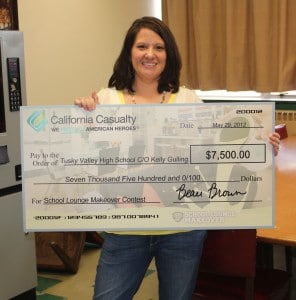
Congratulations, Kelly!
For the last 3 months, the EON Design team has been working hard to give the TVHS Teaching Team the Teachers Lounge they deserve. One with chairs that don’t break when you sit in them, enough space for everyone to enjoy the space, and a decor that is relaxing and soothing.
So here’s what the lounge looked like before the School Lounge Makeover…
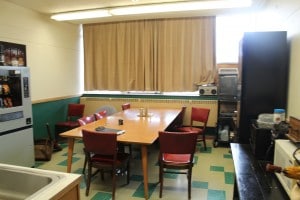
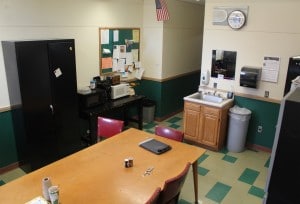
On Tuesday, we revealed the newly made-over TVHS School Lounge!
Are you ready for this?!…

Doesn’t it look fantastic!? I really love the color…

And here’s Kelly, our winner, in the Lounge with her local Union President (far left) and the Principal at TVHS (far right).
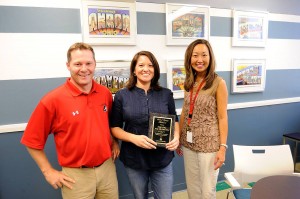
I can’t tell you guys how great it was to see the Before and After of this School Lounge Makeover. The entire community at Tusky Valley High School was a pleasure to meet!
We hope you guys have a rockin new school year in your new lounge! Thanks for letting us get to know your community and reward your educators for everything they do.
by California Casualty | Firefighters, Nurses, Peace Officers, Safety |
Like everyone else across the country, the violent deaths of 12 innocent people in an Aurora, Colorado movie theatre left me heartbroken.
My mind flooded with questions and my heart ached for every victim, every family member, every friend and every member of the Aurora community that was touched by this devastating tragedy.
I was inspired and heartbroken as, one by one, each victim’s story came out. The six-year-old who was out seeing a movie with her babysitter. The two young men who gave their lives to save their girlfriends. The heroic members of the Armed Services who died in that theatre.
The list goes on.
And now, a week out, the question remains: How do we go on? How do we heal?
This question is particularly true of a few certain groups of Heroes. Heroes whose role in responding to tragedies like Aurora story is often overlooked.
The police officers who responded to the horrific scene that night. Who had to put their personal feelings aside to professionally process the scene and eliminate any existing threats- including the booby trapped apartment of the suspect. More Here.
The paramedics who treated and transported victims. Who held it together despite seeing the carnage up close, triaged the 58 innocent people with injuries, and comforted them on their way to hospitals. More here.
The nurses and medical staff who continue to heal survivors. Who tirelessly support their patients down a long and tough road to recovery, answer the tough questions, and experience firsthand the pain, sorrow, and confusion of the victims and their families. More here.
I can’t imagine what it must have been like responding to that scene. The horror of the loss. The pain of injured. The questions of the survivors. So I looked to some of my favorite Police Officer, EMT and Nurse bloggers. I asked them what advice or words of support they could offer to their professional colleagues in this time of processing and healing.
In three posts below, I have posted some fantastic responses, thoughts, and resources from Police Blogger John Marx of Cops Alive, EMT Blogger Captain Morse of Rescuing Providence, and Nurse Blogger Keith Carlson of Digital Doorway.
by California Casualty | Peace Officers |
The Aurora Police Department is receiving wide-spread and well-deserved praise for their response to the Aurora Theatre Shooting tragedy.
On July 20, 2012, they responded as professionals first. But underneath that professional, peace officer exterior is a human being. A human being who cannot help but be impacted by the gruesome scene that morning.
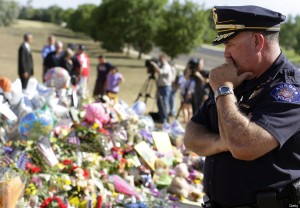 Aurora Police Division Chief Kevin Flynn at an Aurora Memorial (Photo by Joshua Lott/Getty Images)
Survivor Harmony Johnson said it best: “True heroes do come with badges, not with capes.”
To get a Police Officer perspective on responding to and healing from the Aurora tragedy, I turned to John Marx, the amazing Founder of Cops Alive. Cops Alive is an incredible resource for LEOs, with invaluable resources for ‘surviving the job.’ John Marx was gracious enough to share the following with us:
Critical Incident Support for Law Enforcement Officers
by John Marx of CopsAlive.com
Recent events remind us that there are many unexpected situations that will take a toll on the officers and other law enforcement professionals working within your agency.
If you haven’t created a Peer Support System, now is the time to do so. If you already have a Peer Support Program, now is a good time to examine how well you would have been able to support your staff if you have a mass causality incident like the one in Aurora Colorado on July 20, 2012.
At The Law Enforcement Survival Institute and CopsAlive.com, we highly recommend that agencies assess their capabilities to support their staff, both during critical incidents as well as, for the every day caustic rigors of working in law enforcement.
As part of our Armor Your Self™ and Armor Your Agency™ training programs we recommend having numerous systems of support in place, one of the most important of which is a Peer Support Team.
We are very impressed with the work of police psychologist Jack Digliani, Ph.D., Ed.D.. We highly recommend his book as well as his training and the implementation of his Police & Sheriff Peer Support Team concept.
Dr. Digliani is a psychologist and a former deputy sheriff, police officer, and detective. He served as staff psychologist and peer support team clinical supervisor of the Fort Collins, Colorado Police Services for the last 11 years of his police career. He is the author of Reflections of a Police Psychologist and provides training on creating peer support teams for police and sheriff’s agencies. You can learn more about him, his book and his training program, as well as download a free copy of Jack’s “Police & Sheriff Peer Support Team Manual” at: https://www.copsalive.com/digliani/
Here are some of Dr. Digliani’s thoughts about the peer support concept, how it supports officers involved in shootings, and how it can assist in the recovery following a traumatic incident.
Overview
The peer support team is part of each agency’s comprehensive response to an officer- involved incident and is comprised of the agency psychologist and officers trained as peer counselors. The team strives to minimize trauma to the officer and his/her family by assisting them throughout the investigative and return to duty process. Effective intervention will result in the officer returning to duty as soon as possible and continuing to be a productive member of the agency.
Mission
The peer support mission is to provide the officer and family members with emotional support, stress management, and education. In addition, help with trauma recovery, coping strategies to deal with the investigative process as it unfolds, issues surrounding the officer’s response to colleagues and the media and the facilitation of the officer’s return to duty. All interactions with the peer support psychologist are confidential and protected by the privileged communication statute.
Responsibilities
Peer Support serves a supportive rather than investigative or advocacy functions and does not interfere with the investigative process or elicit any details of the incident.
How to Recover from Traumatic Stress
1. Accept your emotions as normal and part of the recovery/survival process.
2. Talk about the event and your feelings.
3. Accept that you may have experienced fear and confronted your vulnerability.
4. Use your fear or anxiousness as a cue to utilize your officer safety skills.
5. Realize that your survival instinct was an asset at the time of the incident and that it remains intact to assist you again if needed.
6. Accept that you cannot always control events, but you can control your response.
7. If you are troubled by a perceived lack of control, focus on the fact that you had some control during the event. You used your strength to respond in a certain way.
8. Do not second-guess your actions. Evaluate your actions based on your perceptions at the time of the event, not afterwards.
9. Understand that your actions were based on the need to make a critical decision for action. The decision likely had to be made within seconds.
10. Accept that your behavior was appropriate to your perceptions and feelings at the time of the incident. Accept that no one is perfect. You may like/dislike some actions.
11. Focus on the things you did that you feel good about. Positive outcomes are often produced by less than perfect actions.
12. Do not take personally the response of the system. Keep the needs of the various systems (DA’s office, administrative investigation, the press, etc) in perspective.
Remember, the event most likely happened because you are a police officer and not because of who you are as a person.
Positive Recovery – keep in mind that you are naturally resilient
1. You will accept what happened. You will accept any experience of fear and any feelings of vulnerability as part of being human. Vulnerability is not helplessness.
2. You will accept that no one can control everything. You will focus on your behaviors and the appropriate application of authority. You will keep a positive perspective.
3. You will learn and grow from the experience. You will be able to assess all future circumstances on their own merits. You will become stronger and smarter.
4. You will include survivorship into your life perspective. You may re-evaluate life’s goals, priorities, and meaning. You will gain wisdom that can come from survivorship.
5. You will be aware of changes in yourself that may contribute to problems at home, work, and other environments. You will work to overcome these problems.
6. You will increase the intimacy of your actions and communications to those you love. You will remain open to the feedback of those who love you.
Getting Help
No one can work through the aftermath of a traumatic incident for you, but you do not have to go it alone. Keep an open mind. Allow your family, friends, and peers to help. Seek professional assistance if you get stuck, if you do not “feel like yourself” or if your friends or family notice dysfunctional emotional responses or behavior. Do not ignore those who care about you. Stay connected to your loved ones.
This article adapts and includes information from the Colorado Law Enforcement Academy Handbook and Reflections of a Police Psychologist (Digliani, J.A., 2010) reprinted with permission.
Please remember that by the nature of our work in law enforcement we will always be called upon to respond to some of the worst and most horrific situations on the planet and that we have volunteered to do so based upon our character, our strengths, our training and our resolve. We cannot ever prepare ourselves fully for what we must face so we must constantly work to increase or resiliency and when we are faced with the worst of the world we must be prepared to accept assistance to ensure that we are able to fully recover and return to our positions of service.
CopsAlive.com and The Law Enforcement Survival Institute offer the Armor Your Self™ training programs to help officer’s survive the toxicity of their careers as well as Armor Your Agency™ programs to help agencies create systems to support their officers and staff.
The Eight Modules of The Armor Your Self™ Program:
1. The “Hidden Dangers” of Law Enforcement and Threat Assessment
2. Armor Your Self™ A New Strategy
3. Armor Your Self™ Physically
4. Armor Your Self™ Mentally
5. Armor Your Self™ Emotionally
6. Armor Your Self™ Spiritually
7. Armor Your Agency™
8. Action Planning for Career Survival
Critical Strategies Discussed in the Armor Your Agency™ Program
1. Mentoring Programs
2. Peer Support
3. Chaplain’s Program
4. Family Support Network
5. Psychological Services
6. Resilience Training & Education
7. Critical Incident Support System
8. Agency Orientation
9. Survivor Support
10. Medical and Wellness Services & Education
CLICK HERE to learn more about Armor Your Self™ Program
CLICK HERE to learn more about Armor Your Agency™ Program
CLICK HERE to read more about or contact The Law Enforcement Survival Institute
CopsAlive.com was founded to provide information and strategies to help police officers successfully survive their careers. We help law enforcement officers and their agencies prepare for the risks that threaten their existence. We will help your agency create the kind of place that supports and protects officers so that they can do their jobs better, safer, longer and survive to tell their grand kids all about it. We think the best strategy is for every officer to create a tactical plan for his or her life and career. We call this Tactical Wellness planning.
The Law Enforcement Survival Institute (LESI) works with individuals and organizations to help them create and sustain success in their lives and careers as law enforcement professionals. It is the primary goal of The Law Enforcement Survival Institute to become the preeminent source for training, resources and information about how to create and sustain a happy, healthy and successful life and career while providing superior law enforcement service to your community.
John Marx, Founder of The Law Enforcement Survival Institute and the Editor of CopsAlive.com. Connect with him on Facebook, LinkedIn and Twitter.
Our sincere Thanks to John Marx for sharing his immense insight and resources with us for this post.